

TL;DR:
- SPF measures protection against UVB rays, not UVA or total sun damage.
- Proper application and reapplication are crucial for actual skin protection.
- Sun protection involves habits and broad-spectrum products, not just high SPF numbers.
SPF numbers are printed on almost every moisturizer, foundation, and sunscreen you own, yet most people are genuinely unsure what those numbers mean. The assumption is simple: higher number, better protection. The reality is more nuanced, and misunderstanding it can leave your skin far more vulnerable than you think. This article breaks down exactly what SPF is, how it protects your skin, where it falls short, and how to choose and use it in a way that actually makes a difference for your long-term skin health.
Table of Contents
- What does SPF really mean?
- How SPF protects your skin from the sun
- SPF in real life: application, limitations, and myths
- Choosing the right SPF for your skin and lifestyle
- A new way to think about SPF—beyond the number on the bottle
- Enhance your skincare routine with trusted SPF products
- Frequently asked questions
Key Takeaways
| Point | Details |
|---|---|
| SPF basics matter | SPF shows how well a product protects against UVB, not total sun safety. |
| Numbers aren’t everything | Higher SPF gives more UVB protection but still requires proper application and reapplication. |
| Smart choices count | Choosing the right SPF for your skin type and routine increases effectiveness. |
| Habits beat hype | Consistent use and reapplication of SPF is more important than simply picking the highest number. |
What does SPF really mean?
SPF stands for Sun Protection Factor. It’s a measurement that tells you how well a sunscreen product protects your skin from UVB rays, the type of ultraviolet radiation most responsible for sunburn and a significant contributor to skin cancer. The number itself is derived from a ratio comparing how much UV energy it takes to cause redness on protected skin versus unprotected skin.
Here’s where most people get tripped up. SPF does not measure total sun protection. It specifically targets UVB radiation and says nothing about UVA exposure unless the product is labeled “broad-spectrum.” UVA rays penetrate deeper into the skin, accelerating aging and contributing to long-term DNA damage. So a product with a high SPF but no broad-spectrum label could let a large portion of harmful radiation through without you knowing it.
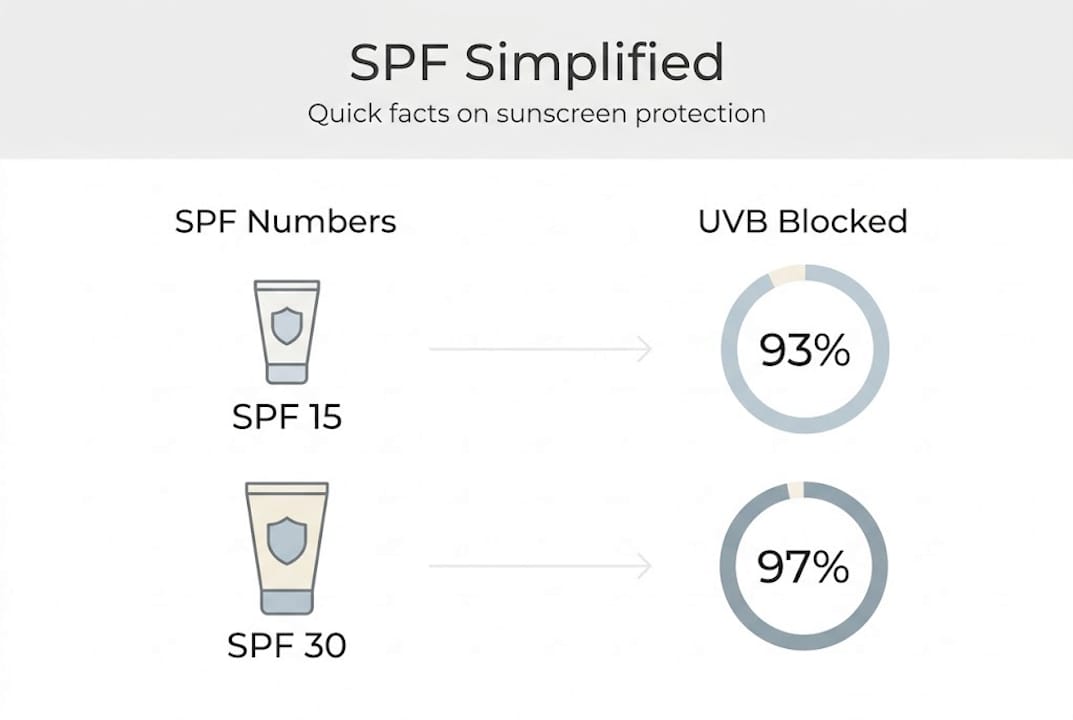
The numbers also don’t scale the way you might expect. SPF 15 blocks about 93% of UVB rays, while SPF 30 blocks around 97%, and SPF 50 blocks roughly 98%. That gap between SPF 30 and SPF 100 is much smaller in reality than it looks on the bottle.
| SPF level | UVB rays blocked |
|---|---|
| SPF 15 | ~93% |
| SPF 30 | ~97% |
| SPF 50 | ~98% |
| SPF 100 | ~99% |
As you can see, you’re not doubling your protection by doubling the SPF number. You’re gaining a fraction of a percentage point in UVB blockage, not a shield twice as strong. This matters because many people apply less product when they trust a high SPF number, which actually reduces their real-world protection significantly.
It’s also worth noting that SPF testing is standardized and depends on human in-vivo erythema endpoints, meaning the label on your bottle reflects controlled lab conditions. Results vary between products and test conditions, so the number you see is not the whole story once you step outside into heat, humidity, sweat, or physical activity.
“The SPF on the label reflects a standardized test, not the exact protection you’ll experience on a beach, during a workout, or on a cloudy commute.”
Common myths worth clearing up right now:
- Higher SPF lasts longer. False. SPF does not affect how long a sunscreen stays active. It tells you nothing about duration.
- You need less sunscreen with higher SPF. Wrong. The recommended amount stays the same regardless of SPF.
- Cloudy days mean no UV exposure. Not true. Up to 80% of UV rays pass through clouds.
Understanding the role of sunscreen and anti-aging also helps here, because the UVA rays SPF alone doesn’t address are precisely the ones breaking down collagen and speeding up visible aging. For a broader overview of building a protective habit, the everyday sun protection guide on our blog is a practical starting point.
How SPF protects your skin from the sun
There are two primary types of ultraviolet radiation that reach your skin every day: UVA and UVB. UVB rays have shorter wavelengths and are the main cause of sunburn. UVA rays have longer wavelengths, penetrate deeper into the dermis, and are largely responsible for premature aging, pigmentation changes, and deeper tissue damage. Both contribute to skin cancer risk.
SPF, as measured by standard testing, primarily captures UVB protection. That’s useful, but it’s an incomplete picture unless your product also addresses UVA. This is exactly why dermatologists and skin experts consistently recommend broad-spectrum sunscreens that address both wavelengths rather than chasing the highest SPF number on a non-broad-spectrum product.
According to guidance from the Cleveland Clinic, higher SPF does increase UVB protection, but it can create a false sense of security. If you don’t apply enough product and don’t reapply throughout the day, the actual protection you receive drops sharply, regardless of what the label promises.
Here’s a key fact that surprises a lot of people: most individuals apply only 25% to 50% of the recommended amount of sunscreen. That dramatic under-application effectively cuts your actual SPF protection in half or more. If you apply half the recommended amount of SPF 50, you may be getting closer to SPF 7 or SPF 10 in practice.
How to optimize SPF protection every time:
- Apply sunscreen 15 to 30 minutes before sun exposure to allow it to bind properly to your skin.
- Use about one ounce (roughly a shot glass full) for your entire body, and about a nickel-sized amount for your face alone.
- Cover commonly missed spots: ears, back of the neck, tops of feet, and hands.
- Reapply every two hours without exception, and immediately after swimming or towel-drying.
- Choose a broad-spectrum product with at least SPF 30 for daily use.
- Layer other protective habits over your sunscreen: wear UV-protective clothing, seek shade between 10 a.m. and 4 p.m., and wear a wide-brimmed hat.
Pro Tip: Set a phone alarm to remind you to reapply. It sounds simple, but most sun damage happens because people forget. One application at 8 a.m. is gone long before noon.
For more detail on why skipping this step has real consequences, read about the benefits of sunscreen daily and look at our resource on sun damage prevention to understand what consistent exposure actually does to your skin over time.
SPF in real life: application, limitations, and myths
Knowing what SPF measures is one thing. Understanding how it behaves on actual skin, in real conditions, is where sun protection either works or fails. Most people buy a good sunscreen and assume the job is done. It’s not.
The single most common reason people get burned while wearing sunscreen is under-application. Testing labs apply sunscreen at 2 milligrams per square centimeter of skin. In practice, most people apply somewhere between 0.5 and 1.5 milligrams per square centimeter. That’s not laziness, it’s just the nature of trying to rub in a product that feels thick or greasy. The result is that real-world SPF performance consistently falls below what the label promises, because standardized testing conditions don’t fully reflect everyday wear.

Sweat, water, and even simply touching your face or wiping with a towel reduce the SPF film on your skin faster than most people realize. Water-resistant sunscreens help, but no sunscreen is waterproof. The FDA limits “water-resistant” claims to either 40 or 80 minutes of protection during water activity, after which reapplication is necessary regardless of SPF strength.
Common myths that increase your real-life risk:
- SPF 100 lasts all day. Absolutely false. No SPF rating changes the two-hour reapplication rule.
- Makeup with SPF is enough. Foundation with SPF 15 applied at normal makeup thickness provides far less protection than a dedicated sunscreen layer, because people don’t apply foundation in the same amounts as sunscreen.
- Dark skin doesn’t need sunscreen. Melanin offers some natural protection, but all skin tones are susceptible to UV damage, aging, and skin cancer.
- Sunscreen is only for summer. UV radiation is present year-round and still penetrates on overcast days.
To build a smarter routine around what’s realistic for your lifestyle, reviewing how to pick sunscreen can help narrow your options. If you’re curious about formula types, our breakdown on mineral sunscreen explains the difference between chemical and physical filters and why your choice of formula also affects real-world application behavior.
Pro Tip: If you find sunscreen too heavy or greasy to apply liberally, switch to a lighter gel or water-based formula. You’ll apply more of it, and more product means more actual protection.
Choosing the right SPF for your skin and lifestyle
Picking an SPF product isn’t just about grabbing the highest number on the shelf. Your skin type, your daily routine, where you live, and how much time you spend outdoors all influence what SPF level and product formula will actually work for you.
General SPF recommendations by skin type and activity:
- Fair skin: SPF 50 or higher for daily use, especially outdoors. Fair skin burns faster and has a higher lifetime risk of UV damage.
- Medium skin: SPF 30 to 50 for everyday wear. SPF 50 or higher for extended outdoor exposure or high-altitude environments.
- Darker skin tones: SPF 30 minimum for daily protection. Melanin provides some buffer but not immunity to UV damage, hyperpigmentation, or long-term aging.
- Acne-prone or sensitive skin: Look for oil-free or non-comedogenic formulas. Mineral filters (zinc oxide or titanium dioxide) tend to be gentler and less likely to trigger breakouts.
Factors beyond skin tone also matter significantly. People who work outdoors, exercise outside regularly, or live at higher altitudes face intensified UV exposure and need higher SPF and more frequent reapplication. Those living in equatorial climates face year-round intense UV index levels, making SPF 50 a practical daily minimum. Even office workers who commute by car are exposed to UVA rays through glass, making daily SPF a smart habit regardless of how much time you think you spend outside.
Steps to choose the right SPF for your routine:
- Assess your daily UV exposure: how long are you actually outdoors each day?
- Match your formula to your skin type: gel for oily skin, cream for dry skin, and stick formulas for easy reapplication on the go.
- Confirm the label says broad-spectrum. This is non-negotiable for real protection.
- Choose SPF 30 as a baseline for indoor-dominant days and SPF 50 for any outdoor activity.
- Check water resistance if you exercise, swim, or sweat heavily.
- Test it in your actual routine. If you hate the texture, you won’t use it consistently, and consistency matters more than SPF number.
Habits that make SPF part of your daily routine:
- Keep a dedicated SPF product next to your toothbrush or morning moisturizer so it becomes automatic.
- Use a moisturizer with SPF on low-sun days, and layer a dedicated sunscreen on top for high-exposure days.
- Carry a travel-size SPF for midday reapplication at work or on the go.
- Apply SPF to your neck, chest, and hands daily, not just your face. These areas age visibly and are frequently forgotten.
For a detailed selection framework, our sunscreen selection guide walks through formulas, filters, and skin compatibility step by step. And if protecting against aging is a priority alongside sun damage, our piece on sunscreen for anti-aging shows exactly how SPF fits into a long-term skin health strategy.
A new way to think about SPF—beyond the number on the bottle
Here’s an opinion you don’t hear often enough: obsessing over SPF numbers is one of the least effective ways to protect your skin. The data backs this up. SPF testing is standardized but doesn’t reflect all real-world variables, meaning the controlled lab number on your bottle can diverge significantly from your actual protection on a July afternoon.
The real differentiator in skin protection is not whether you chose SPF 70 over SPF 50. It’s whether you applied enough, reapplied on schedule, and covered the right areas consistently over months and years. Someone who applies SPF 30 correctly every single day will have meaningfully better sun protection outcomes than someone who applies SPF 100 incorrectly twice a week.
This shifts the focus from product shopping to habit building. Sun protection is a behavior, not just a product category. The number on the label gives you a useful baseline, but it cannot override human error in application. Understanding the full picture of sun damage over time reinforces why the daily discipline matters far more than any single product claim.
Think of SPF as one tool in a wider system, not the whole system itself.
Enhance your skincare routine with trusted SPF products
Ready to put everything you’ve learned into practice? Choosing the right SPF product for your skin is the first step, and having quality options makes that step a lot easier.

At Skin-Styles.com, you’ll find a curated selection of facial creams with SPF, from lightweight daily gels to richer formulas designed for both moisture and protection. If you’re looking for a trusted brand with a track record in sun protection, explore the Cosrx sun protection range for formulas that suit a wide range of skin types and lifestyles. Browse by texture, SPF level, and formula type to find your best daily match and make SPF a non-negotiable part of your skincare routine.
Frequently asked questions
Does a higher SPF mean better overall protection?
Higher SPF blocks more UVB rays but does not guarantee full protection, especially if not applied or reapplied correctly. It also provides no additional UVA protection unless labeled broad-spectrum.
Is SPF all you need for complete sun protection?
No. SPF addresses mainly UVB rays, and complete protection also requires protective clothing, hats, sunglasses, and seeking shade during peak UV hours.
How often should I reapply sunscreen with SPF?
Reapply every two hours during sun exposure. Reapply more frequently if you swim or sweat heavily, regardless of your sunscreen’s SPF rating.
What does broad-spectrum SPF mean?
Broad-spectrum SPF protects against both UVA and UVB rays. Without that label, your sunscreen’s UVA coverage is not guaranteed, leaving your skin vulnerable to deeper UV damage.
Is SPF in email security related to skincare SPF?
No. The SPF acronym in email technology stands for Sender Policy Framework, an email authentication protocol that is completely unrelated to ultraviolet sun protection in skincare.