
TL;DR:
- Fragrance-free means no scent chemicals are added; unscented products may still contain masking agents.
- Fragrances are common triggers for contact dermatitis, eczema, and skin sensitivity, especially with long-term use.
- Reading ingredient lists carefully helps identify true fragrance-free products, benefiting sensitive and reactive skin.
Fragrance is the ingredient most people never think twice about, yet it sits quietly in your moisturizer, cleanser, and toner, potentially doing real harm. It smells luxurious, it feels intentional, and it makes a product feel premium. But fragrance is the leading cause of cosmetic contact dermatitis worldwide, and millions of people with sensitive or allergy-prone skin are paying the price without even realizing it. This article breaks down exactly what fragrance-free skincare means, why it matters for your skin health, how to find genuinely fragrance-free products, and who benefits most from making the switch.
Table of Contents
- What does fragrance-free really mean?
- Why choose fragrance-free skincare?
- How to identify truly fragrance-free skincare products
- Who should avoid fragrances and who might not need to?
- Why most people underestimate fragrance in skincare
- Discover gentle, effective fragrance-free skincare options
- Frequently asked questions
Key Takeaways
| Point | Details |
|---|---|
| Fragrance often causes irritation | Fragrance is one of the most common causes of cosmetic allergic reactions. |
| Understand product labels | ‘Fragrance-free’ and ‘unscented’ have important differences for sensitive skin. |
| Not just for allergies | Fragrance-free skincare benefits everyone, but especially those with sensitive or eczema-prone skin. |
| Always check ingredients | Ingredient lists may reveal hidden fragrance sources not obvious from product labeling. |
What does fragrance-free really mean?
Not all “free” claims on skincare labels mean the same thing. The term fragrance-free is one of the most misunderstood in the beauty industry, and the confusion is partly by design.
Fragrance-free means that no fragrance chemicals have been added to the product to give it a scent. The formula contains zero ingredients whose sole purpose is to make it smell good. That is the clean, simple definition.
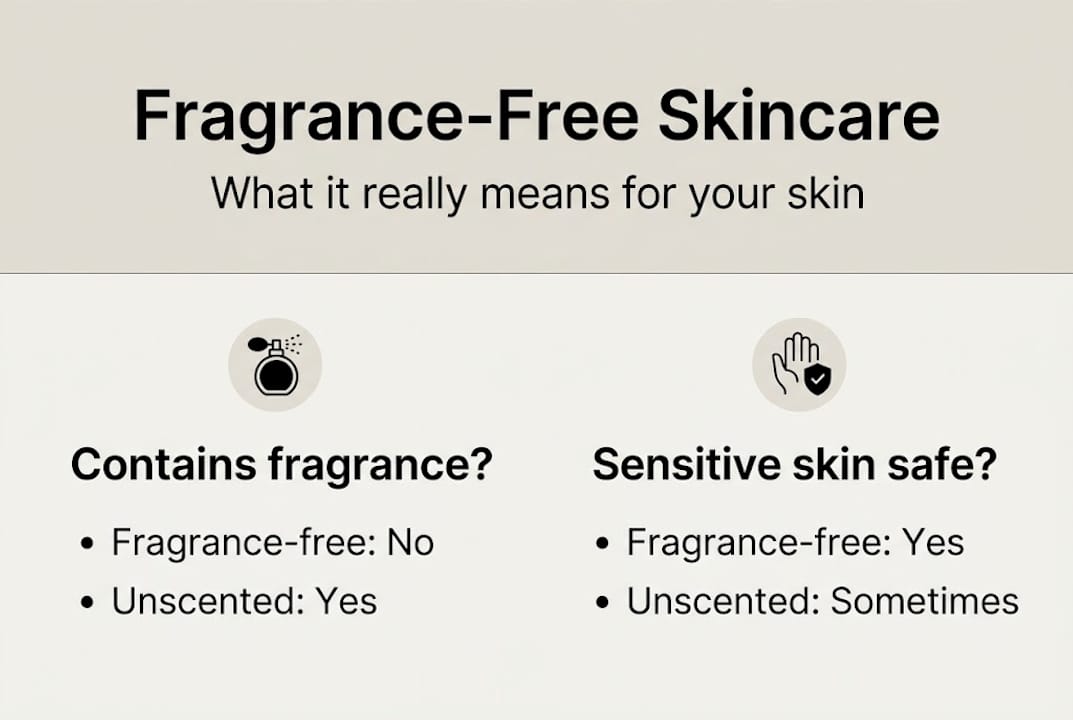
Unscented is a completely different story. An unscented product may still contain chemicals called masking agents. These ingredients neutralize the natural smell of the formula so the product has no noticeable odor. They are technically fragrance chemicals, just working in reverse. If you have sensitive skin and you reach for an “unscented” product thinking it is safe, you may still be exposing your skin to the same irritants you were trying to avoid.
Here is a quick comparison to make this clearer:
| Term | Contains fragrance chemicals? | Safe for sensitive skin? |
|---|---|---|
| Fragrance-free | No | Generally yes |
| Unscented | Possibly (masking agents) | Not guaranteed |
| Natural fragrance | Yes (from plant sources) | Not always |
| Perfume/parfum | Yes | Often no |
Regulatory definitions also vary by country, which adds another layer of confusion. In the United States, the FDA does not require manufacturers to disclose every individual fragrance ingredient. They can simply list “fragrance” or “parfum” as a single umbrella term, hiding dozens of potential allergens behind one word. The AAD recommends fragrance-free products for anyone with sensitive skin, specifically because of this labeling gap.
Common hidden fragrance sources to watch for include:
- Parfum or fragrance (catch-all terms)
- Essential oils (lavender, eucalyptus, rose)
- Linalool and limonene (common allergens found in natural extracts)
- Citronellol and geraniol (often in botanical formulas)
- Benzyl alcohol (sometimes used as a preservative but also a fragrance component)
Pro Tip: Do not stop at the front label. Flip the product over and read the full ingredient list. If you see “parfum,” “fragrance,” or any essential oil, the product is not truly fragrance-free regardless of what the front label claims. For more guidance, explore moisturizer tips for sensitive skin to understand what to look for in a safe formula, and check out clean beauty explained for a broader look at ingredient transparency.
Why choose fragrance-free skincare?
With the definitions clear, it is important to understand exactly why fragrance-free matters for your skin health.
Fragrances are among the most common triggers of contact dermatitis, which is a skin reaction that causes redness, itching, swelling, or a rash after contact with an irritating substance. This is not a rare issue. Fragrance affects up to 8 to 12% of dermatitis patients, and when you scale that to the global population, you are talking about tens of millions of people reacting to something in their daily skincare routine.
The problem is that reactions are not always immediate or dramatic. Some people experience a slow buildup of sensitivity over months or years. They use a scented product every day, notice mild redness or dryness, and assume it is just their skin being difficult. In reality, the fragrance is quietly inflaming the skin barrier over time.
Here is why fragrance-free skincare is the smarter choice for reactive skin:
- Reduced irritation risk. Removing fragrance eliminates one of the most common triggers for skin reactions.
- Stronger skin barrier. Fragrance chemicals can disrupt the skin’s natural protective layer, making it more prone to moisture loss.
- Fewer flare-ups. People with eczema, psoriasis, or rosacea often see fewer and less severe flare-ups when they switch to fragrance-free formulas.
- Safer for daily use. Fragrance-free products are gentler for long-term, everyday application.
- Better tolerance for layering products. When each product in your routine is fragrance-free, the cumulative irritation risk drops significantly.
“The American Academy of Dermatology recommends fragrance-free products for individuals with sensitive skin, eczema, or a history of allergic reactions to skincare.”
Children and elderly individuals also carry a higher risk because their skin barriers are naturally thinner or more compromised. For anyone in these groups, fragrance-free is not optional. It is the baseline. If you have ever dealt with unexplained redness or itching after applying a product, exploring allergy-friendly skincare and reviewing our sensitive skin guide can help you identify and eliminate common triggers.
How to identify truly fragrance-free skincare products
Knowing the benefits, your next task is to confidently spot truly fragrance-free products amidst misleading marketing.
The front of a product package is a marketing tool. The back is where the truth lives. Learning to read ingredient labels is the single most important skill for finding genuinely fragrance-free skincare.

Here is what the most common label terms actually mean:
| Label term | What it means | Fragrance-free? |
|---|---|---|
| Fragrance-free | No added fragrance chemicals | Yes |
| Unscented | May contain masking agents | Not necessarily |
| Hypoallergenic | Formulated to reduce allergy risk | Not guaranteed |
| Natural | Uses plant-derived ingredients | No, often contains essential oils |
| Dermatologist-tested | Tested by a dermatologist | Does not confirm fragrance-free |
Use this checklist before purchasing any skincare product:
- Read the full ingredient list, not just the front label.
- Search for the words “parfum,” “fragrance,” or “aroma” anywhere in the list.
- Check for essential oils by name (lavender oil, tea tree oil, rose extract).
- Look for known fragrance allergens like linalool, limonene, citronellol, or eugenol.
- Verify the product is labeled fragrance-free, not just unscented.
- Cross-reference with a trusted ingredient database if you are unsure about a specific chemical.
Petrolatum and mineral oil in fragrance-free moisturizers are especially recommended for sensitive skin because they create a protective barrier without any risk of fragrance-related irritation. These are some of the safest, most studied ingredients available.
Pro Tip: When shopping online, use the product description search function to look for the word “fragrance-free” specifically. If a brand does not clearly state it, assume the product contains fragrance. Also, look for products with shorter ingredient lists. Fewer ingredients generally means fewer opportunities for hidden irritants. For help evaluating cleansers specifically, our guide on cleanser tips for sensitive skin walks you through what to look for and what to avoid.
Who should avoid fragrances and who might not need to?
Even within the gentle skincare movement, fragrance-free is not always a hard rule for everyone. Let us clarify who benefits most.
Some people genuinely have no issues with fragranced products. If you have resilient, non-reactive skin and no history of allergies or skin conditions, a well-formulated product with a mild fragrance may not cause you any problems. Skin tolerance varies widely, and not everyone needs to overhaul their routine.
However, the risk is real and significant for specific groups. Fragrance impacts up to 1 to 3% of the general population and a much higher share among people already dealing with skin conditions. That percentage climbs steeply once you factor in people who have not yet identified fragrance as their trigger.
People who should always choose fragrance-free skincare:
- Those diagnosed with eczema (atopic dermatitis)
- Anyone with contact dermatitis or a known fragrance allergy
- People with rosacea or psoriasis
- Individuals with autoimmune skin disorders
- Babies and young children
- Elderly individuals with thinning or compromised skin
- Anyone with a history of unexplained skin reactions
“If you are unsure whether you have a fragrance sensitivity, the safest clinical approach is to assume you do and choose fragrance-free products as your default.”
For healthy adults without any known sensitivities, the choice is more personal. But here is the thing: there is no skincare benefit to fragrance itself. It does not moisturize, protect, or repair. It only adds scent. So even if you are not sensitive right now, avoiding fragrance is a low-risk, high-reward decision. For practical strategies on day-to-day care, our article on managing sensitive skin offers a solid foundation.
Why most people underestimate fragrance in skincare
Here is something worth sitting with: the skincare industry has spent decades associating scent with quality. A product that smells like roses or fresh citrus feels more luxurious, more effective, more worth the price. That emotional connection is powerful, and it works. Most people never question it.
But that association is a marketing construct, not a skincare truth. Fragrance adds zero functional value to your skin. It is there to influence how you feel about the product, not what the product actually does.
The other misconception is that irritation only happens to people with “really sensitive” skin. Many people dismiss mild redness, persistent dryness, or occasional itching as just their skin being temperamental. They never connect it to the scented moisturizer they apply every morning. Even “natural” fragrances derived from plants can trigger reactions because the skin does not distinguish between synthetic and natural irritants. It only knows whether a chemical is causing inflammation.
Our experience at Skin-Styles tells us that once people switch to genuinely fragrance-free formulas and follow an expert guide for sensitive skin, many are surprised by how much calmer and more balanced their skin becomes. The lesson: always check ingredients, and do not let the marketing front make that decision for you.
Discover gentle, effective fragrance-free skincare options
If you are ready to build a fragrance-free routine, you do not have to sort through hundreds of products on your own. At Skin-Styles, we have done the work for you.

Our fragrance-free facial creams collection features carefully selected formulas designed for sensitive, reactive, and allergy-prone skin. If you are a fan of trusted K-beauty, our Cosrx fragrance-free options offer gentle, clinically minded products with minimal irritants. And if you are focused on aging concerns without the sensitivity risk, our anti-wrinkle fragrance-free range delivers effective results without compromising your skin barrier. Browse by skin concern, ingredient preference, or product type to find exactly what your skin needs.
Frequently asked questions
Does fragrance-free mean no scent at all?
Fragrance-free means no fragrance chemicals were added, but the product may still carry a faint natural scent from its base ingredients like oils or plant extracts.
Are natural essential oils safe for sensitive skin?
Essential oils are plant-derived but can still cause irritation or allergic reactions, particularly in people with sensitive or reactive skin.
Can fragrance-free products help with eczema?
Yes. The AAD recommends fragrance-free moisturizers for eczema-prone skin specifically because fragrance is a common trigger for flare-ups and irritation.
How can I spot hidden fragrance ingredients on labels?
Scan the ingredient list for terms like parfum, fragrance, linalool, citronellol, and any listed essential oil names, which are all potential fragrance sources.
Is fragrance-free skincare only for people with allergies?
No. While it is critical for those with allergies or chronic skin conditions, fragrance-free is recommended for anyone with sensitive skin and is a smart, low-risk choice for virtually everyone.