
TL;DR:
- Skincare labels have two main sections: the front product identity and the detailed information panel.
- Ingredient order indicates concentration; first-listed ingredients are most abundant and impactful.
- Use hazard databases like EWG or CosDNA to assess ingredient safety and avoid hidden chemicals like PFAS.
You bought a moisturizer labeled “dermatologist-recommended” and “100% natural,” and your skin still broke out. Sound familiar? The problem usually isn’t your skin type. It’s the label. Skincare packaging is designed to sell, not necessarily to inform, and the gap between what the front of a bottle promises and what the ingredient list actually contains can be enormous. Learning to read a skincare label is one of the most practical skills you can build for your routine. This guide walks you through every section of a label, from the required FDA elements to ingredient red flags, so you can shop with real confidence.
Table of Contents
- What’s on a skincare label: The essential elements
- How to interpret ingredient lists: Order, concentration, and red flags
- Safety, hazards, and ingredient tools: Making sense of complex names
- Synthetic versus natural: The ingredient debate and your skin
- Why decoding skincare labels matters more now than ever
- Where to find trusted, transparent skincare
- Frequently asked questions
Key Takeaways
| Point | Details |
|---|---|
| Read the ingredient order | The first five to seven ingredients make up the bulk of the formula and reveal a product’s true focus. |
| Spot red flag chemicals | Watch for controversial ingredients like PFAS or undisclosed fragrance blends. |
| Verify claims with tools | Use safety databases like EWG Skin Deep to cross-check unfamiliar or complex ingredient names. |
| Balance natural and synthetic | Understand that both natural and synthetic ingredients offer benefits and risks—your skin’s reaction matters most. |
| Prioritize clear labeling | Trust products with transparent labeling and easy-to-access safety information. |
What’s on a skincare label: The essential elements
Before you can decode a label, you need to know where to look. The FDA divides cosmetic packaging into two main zones, each with a specific job.
The Principal Display Panel (PDP) is the front-facing section. It carries the product’s identity (what it is), the brand name, and the net quantity of contents. This is the section most brands invest heavily in designing because it drives first impressions on shelves. It’s also the section most likely to carry marketing language like “brightening,” “anti-aging,” or “clean beauty.”
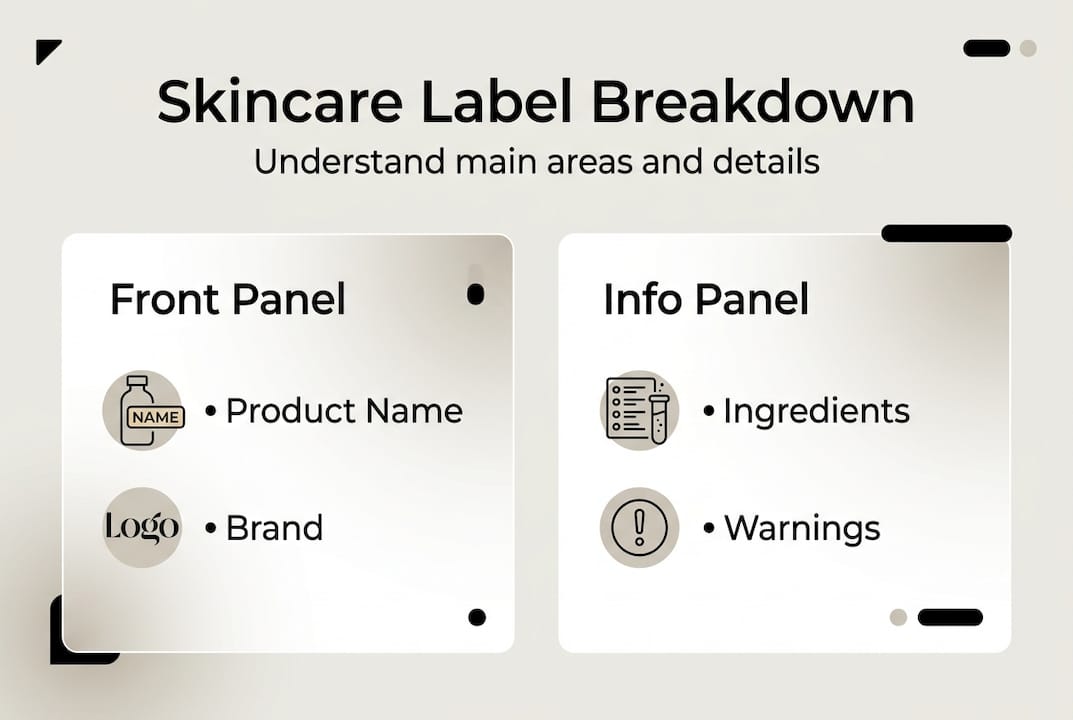
The Information Panel is where the real data lives. Per FDA-required label elements, this panel must include the full ingredient list, the manufacturer’s name and address, and any required warnings. Warnings must appear in a typeface no smaller than 1/16 inch, with clear contrast against the background. One important caveat: not all allergen warnings are required, so you can’t rely on the label alone to catch every potential irritant.
Here’s a quick breakdown of what each section must legally contain:
| Label section | Required content |
|---|---|
| Principal Display Panel | Product identity, brand name, net quantity |
| Information Panel | Ingredient list, manufacturer info, warnings |
| Warning text | Minimum 1/16 inch typeface, clear contrast |
Key elements you should always locate on any product:
- Product identity: What the product claims to be (serum, moisturizer, toner)
- Net quantity: How much product you’re actually getting
- Manufacturer or distributor name and address: Useful for tracing accountability
- Full ingredient list (INCI names): International Nomenclature of Cosmetic Ingredients, the standardized naming system
- Warnings: Especially relevant for products with active ingredients like retinol or AHAs
Understanding what is skincare basics helps you connect these label sections to your actual routine. Once you know what each part of the label is supposed to tell you, reading it becomes much faster.
How to interpret ingredient lists: Order, concentration, and red flags
The ingredient list is the most honest part of any skincare product, if you know how to read it. Ingredients are listed in descending order of concentration by weight. That means the first ingredient is present in the highest amount, and the last is present in the smallest. According to FDA cosmetic labeling rules, the first 5 to 7 ingredients typically make up 80 to 90% of the formula.

Below a 1% concentration threshold (often signaled by the appearance of preservatives like phenoxyethanol), the order becomes less strict. Brands can arrange those trace ingredients in any order they choose. This matters because a brand can list a trendy active like niacinamide or vitamin C near the top of the label’s marketing copy, while burying it near the bottom of the actual ingredient list.
Here’s how a “clean” label compares to a marketing-heavy one:
| Feature | Transparent label | Marketing-heavy label |
|---|---|---|
| Key actives | Listed in top 5 ingredients | Listed near the bottom |
| Fragrance | Absent or clearly listed | Hidden as “parfum” |
| Preservatives | Named specifically | Vague or omitted |
| Filler ratio | Low (water, glycerin minimal) | High (mostly water and fillers) |
Common red flags to watch for:
- Parabens (methylparaben, propylparaben): Preservatives with ongoing debate around hormonal disruption
- Phthalates: Often hidden inside “fragrance” listings
- Vague fragrance listings: “Parfum” or “fragrance” can mask dozens of undisclosed chemicals
- Alcohol denat (denatured alcohol) high in the list: Can be drying and irritating for sensitive skin
- Formaldehyde-releasing preservatives: Names like DMDM hydantoin or quaternium-15
Pro Tip: If a hero ingredient like hyaluronic acid or retinol appears after phenoxyethanol in the list, it’s likely present in a concentration too low to make a real difference. Check natural skincare ingredients to understand which actives need to be in the top half of a formula to work. And when you’re layering skincare products, knowing each product’s active concentration helps you stack them in the right order for maximum benefit.
Safety, hazards, and ingredient tools: Making sense of complex names
Ingredient names on skincare labels can look like a chemistry exam. “Butylphenyl methylpropional” sounds alarming. “Sodium hyaluronate” sounds clinical but is simply hyaluronic acid in salt form. The name alone tells you very little about safety.
This is where digital tools become essential. The EWG Skin Deep database rates individual ingredients and full products on a hazard scale from 1 to 10, where 1 is low hazard and 10 is high concern. It’s not a perfect system, but it gives you a fast starting point for unfamiliar names. The EWG Skin Deep ratings also flag PFAS (per- and polyfluoroalkyl substances), often called “forever chemicals,” which the FDA found in over 1,700 personal care products.
To spot PFAS on a label, scan for ingredient names containing:
- “Fluoro” or “perfluoro” (e.g., perfluorooctyl triethoxysilane)
- “PTFE” (polytetrafluoroethylene, often used in primers and foundations for a smooth finish)
- “Fluorinated” anywhere in the INCI name
Important: Not every chemical-sounding ingredient is dangerous. Sodium ascorbyl phosphate is a stable form of vitamin C. Dimethicone is a silicone that protects the skin barrier. Some synthetic ingredients are actually safer and more stable than their natural counterparts. The goal is informed evaluation, not blanket fear.
Pro Tip: When you encounter an unfamiliar ingredient, search it directly in the EWG Skin Deep database or the CosDNA analyzer before making a purchase. Both tools show hazard scores, known functions, and flagged concerns in under a minute.
Resources worth bookmarking:
- EWG Skin Deep: Hazard ratings for ingredients and full products
- CosDNA: Acne and irritant flags, useful for sensitive skin
- INCI Decoder: Explains what each ingredient actually does in a formula
- Think Dirty app: Mobile-friendly product scanner with ingredient breakdowns
For a deeper look at how natural vs. synthetic ingredients stack up in real formulas, the distinction is often more nuanced than the marketing suggests.
Synthetic versus natural: The ingredient debate and your skin
The word “natural” appears on thousands of skincare products, but the FDA does not regulate or define it as a cosmetic claim. Any brand can print it on a label without meeting a single specific standard. The same goes for “clean,” “green,” and “non-toxic.” These are marketing terms, not legal definitions.
Here’s the uncomfortable truth: natural does not automatically mean safe, and synthetic does not automatically mean harmful. Poison ivy is natural. So is arsenic. Meanwhile, lab-created ingredients like peptides, ceramides, and niacinamide have decades of clinical research supporting their safety and effectiveness. The FDA’s findings on PFAS in over 1,700 personal care products remind us that even widely used synthetic ingredients need scrutiny, but that scrutiny should be evidence-based, not reflexive.
Statistic worth noting: EWG flagged over 50 distinct PFAS ingredients intentionally added to personal care products as of 2026. That’s a real concern backed by data, not just marketing fear.
Before you buy, ask yourself:
- Does this product list its actives clearly and high in the ingredient list?
- Are there any fragrance or “parfum” entries that could mask allergens?
- Does my skin have known sensitivities to any listed ingredients?
- Is the “natural” or “clean” claim backed by a third-party certification?
- Have I checked the top 5 ingredients against a safety database?
The goal isn’t to avoid all synthetics or embrace all naturals. It’s to identify truly natural ingredients that work for your specific skin and pair them with evidence-backed synthetics when needed. Your skin’s reaction is always the final test.
Why decoding skincare labels matters more now than ever
Here’s something most label-reading guides won’t tell you: the skill of reading a label is only half the battle. The harder part is maintaining healthy skepticism as formulas, regulations, and marketing tactics keep evolving.
FDA cosmetic regulations have historically lagged behind the pace of cosmetic innovation. New ingredients enter the market faster than safety data can catch up. Brands exploit this gap with “free from” lists that remove one questionable ingredient while quietly adding another. Greenwashing has become so sophisticated that even experienced shoppers get misled.
True label literacy means treating every product as a starting point for questions, not a finished answer. Your skin’s reaction over time tells you more than any certification logo. We’ve seen customers swear by a “clean” product that caused persistent redness, and others thrive on formulas with long synthetic ingredient lists.
The brands worth trusting are the ones that make transparency easy, not the ones that make marketing look like transparency. Exploring beyond natural skincare basics is a good next step for building that critical eye. Read labels, use the tools, and then listen to your skin.
Where to find trusted, transparent skincare
Knowing how to read a label is powerful. Finding products that make that reading easy is the next step.

At Skin-Styles.com, we curate collections with ingredient clarity in mind. Whether you’re browsing facial creams and gels for daily hydration, exploring the Cosrx collection for science-backed Korean skincare, or searching for targeted anti-wrinkle formulas, you’ll find products from brands that prioritize honest labeling. Use the label skills you’ve built here to compare formulas, check active placement, and choose what genuinely fits your skin. Transparent skincare isn’t a trend. It’s the standard you deserve.
Frequently asked questions
What are the first ingredients I should look for on a skincare label?
Focus on the first 5 to 7 ingredients, since they make up 80 to 90% of the formula by weight and determine most of the product’s real-world performance.
How do I tell if a skincare product contains PFAS or other “forever chemicals”?
Scan the ingredient list for names containing “fluoro,” “perfluoro,” or “PTFE,” and cross-check with the EWG Skin Deep database, which tracks PFAS in 1,700+ products.
Is “natural” skincare always better than synthetic?
Not always. Many synthetics are safe and effective, while some natural substances like essential oils or botanical extracts can trigger irritation or allergic reactions in sensitive skin.
Where should I look for allergen warnings on skincare products?
Allergen warnings appear on the Information Panel when required, but the FDA does not mandate disclosure of all potential allergens, so checking the full ingredient list yourself remains essential.