

TL;DR:
- Your skin’s microbiome is a complex ecosystem essential for skin protection and health.
- Disrupting the microbiome through harsh products can lead to skin issues like inflammation and breakouts.
- Supporting the microbiome with gentle routines and targeted products promotes resilient, healthy skin.
Most people think the goal of skincare is to get rid of as many germs as possible. Scrub harder, sanitize more, and you’ll have healthier skin. That idea is not just wrong. It’s actually working against you. Your skin is home to trillions of bacteria, fungi, viruses, and mites that form a living ecosystem called the skin microbiome. These microorganisms are not invaders. They are essential partners that protect, regulate, and maintain your skin every single day. This article breaks down what the skin microbiome is, how it works, what throws it off balance, and what you can do to support it through your everyday beauty routine.
Table of Contents
- What exactly is the skin microbiome?
- How your skin microbiome protects and balances your skin
- What happens when the skin microbiome is out of balance?
- How your routine and habits shape the skin microbiome
- Science and future of skin microbiome care
- Why a healthy skin microbiome is more than just a trend
- Support your skin’s microbiome with the right products
- Frequently asked questions
Key Takeaways
| Point | Details |
|---|---|
| Microbiome is essential | Your skin hosts an invisible ecosystem crucial to barrier and immune function. |
| Balance prevents skin issues | A balanced microbiome helps avoid conditions like acne and eczema. |
| Care habits matter | Simple choices like gentle cleansing and routine adjustments can support microbiome health. |
| Emerging science | New treatments like probiotics and phage therapy may further improve skin health in the future. |
What exactly is the skin microbiome?
Think of your skin as a planet. On its surface and inside every pore and hair follicle, there are entire communities of living things. The skin microbiome is the collective name for all of these organisms, and it is far more complex than most people realize.
According to research, bacteria, fungi, viruses, and mites all make up part of this ecosystem, living on your skin’s surface and deep within hair follicles. You cannot see them with the naked eye, but they are constantly working.
Here is a quick breakdown of who lives on your skin:
- Bacteria: The most studied group. Species like Staphylococcus epidermidis are protective and common on healthy skin.
- Fungi: Malassezia is found on most people and plays a role in conditions like dandruff and seborrheic dermatitis.
- Viruses: Mostly bacteriophages, which are viruses that target bacteria rather than human cells.
- Mites: Tiny organisms like Demodex live in hair follicles and are present in nearly all adults.
What makes the microbiome fascinating is that it is not the same everywhere on your body. Oily areas like your forehead host different communities than dry areas like your forearms or the moist creases behind your knees. Each zone has its own microbiome fingerprint.
“Your skin microbiome is as unique to you as your fingerprint, shaped by your genetics, environment, and daily habits.”
The key functions of a healthy skin microbiome include:
- Regulating skin pH to keep it slightly acidic (around 4.5 to 5.5), which discourages harmful bacteria
- Training your immune system to distinguish between threats and harmless microbes
- Producing antimicrobial compounds that fight off pathogens
- Supporting the skin barrier so moisture stays in and irritants stay out
With roughly 1.8 square meters of skin on the average adult body, that is a lot of real estate for these communities to manage. And they do it constantly, without you noticing.
How your skin microbiome protects and balances your skin
Knowing what the microbiome is, let’s see how it works to protect and maintain healthy, beautiful skin.
Imagine your skin microbiome as a bouncer team at the door of a club. Their job is to check who gets in, keep troublemakers out, and make sure the environment inside stays calm and orderly. When the team is strong and well-staffed, everything runs smoothly. When it’s undermanned or chaotic, problems start.
The microbiome protects against pathogens, supports immune system training, and regulates inflammation. This is not a passive process. Your skin’s microbial community actively competes with harmful bacteria for nutrients and space, making it harder for pathogens to take hold.
Here is how that protection plays out in real terms:
- Pathogen defense: Beneficial bacteria produce acids and antimicrobial peptides that create a hostile environment for harmful microbes.
- Immune calibration: Early exposure to diverse microbes helps your immune system learn what to attack and what to ignore, reducing the risk of overreaction (like allergic responses or chronic inflammation).
- Wound healing: A balanced microbiome supports faster recovery by managing the inflammatory response and preventing infection at wound sites.
- Inflammation control: When microbial balance is maintained, your skin is less likely to flare up in response to minor triggers.
Pro Tip: If you have sensitive skin care tips on your radar, start by looking at whether your cleansing routine is stripping your skin’s natural microbial layer. That alone can cause a lot of the redness and reactivity people blame on other factors.
“A well-balanced microbiome is one of the most powerful natural defenses your skin has. It is not something you can replicate with a product alone.”
The microbiome also plays a direct role in keeping your skin looking good. Balanced microbial communities help maintain skin tone, texture, and that natural glow that no highlighter can fully fake.
What happens when the skin microbiome is out of balance?
With a balanced microbiome, your skin flourishes. But what happens when this mini-ecosystem gets disrupted?
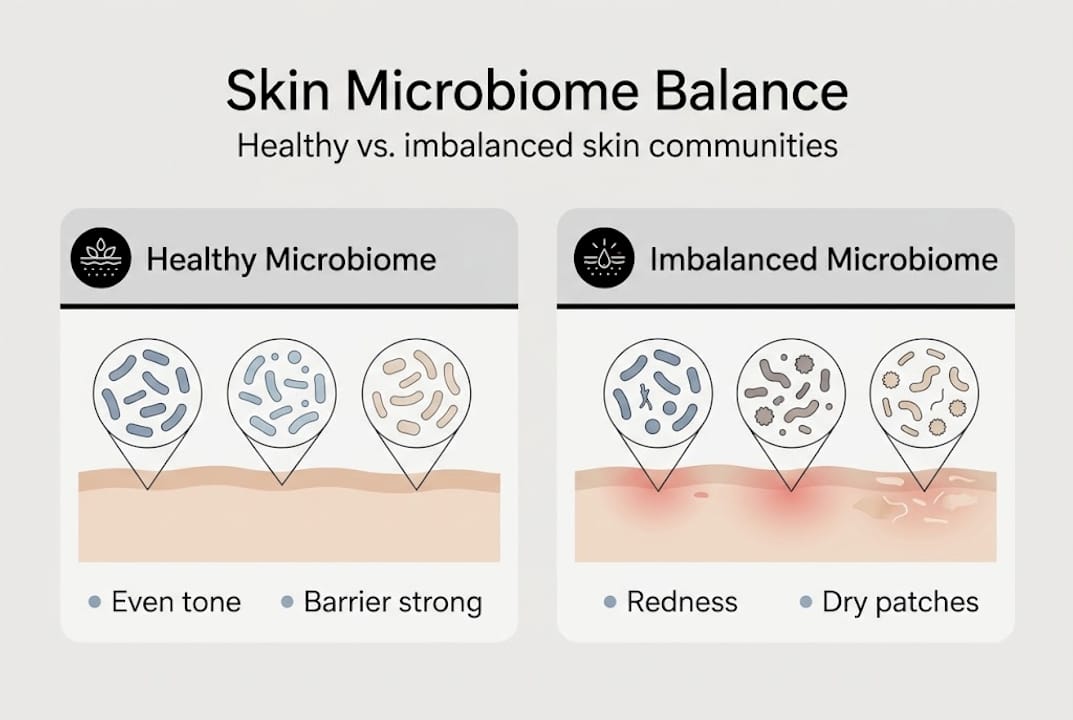
The term for this disruption is dysbiosis, which simply means the microbial community on your skin has shifted in a way that harms rather than helps. Dysbiosis is linked to conditions like atopic dermatitis, psoriasis, acne, and rosacea. These are not just cosmetic concerns. They can significantly affect your quality of life.
Common triggers of dysbiosis include:
- Harsh or antibacterial cleansers used too frequently
- Over-sanitizing skin with alcohol-based products
- Long-term antibiotic use, which wipes out beneficial bacteria alongside harmful ones
- Stress, poor sleep, and a diet high in processed foods
- Environmental factors like pollution and extreme weather
| Healthy microbiome | Imbalanced microbiome |
|---|---|
| Smooth, even skin tone | Persistent redness or blotchiness |
| Resilient skin barrier | Increased sensitivity and dryness |
| Fewer breakouts | Acne or cystic flare-ups |
| Calm immune response | Chronic inflammation or eczema |
| Faster healing | Slow wound recovery |
One of the biggest mistakes people make is reaching for stronger products when their skin acts up. More aggressive cleansing, stronger actives, and more frequent exfoliation can feel like the right move, but they often make dysbiosis worse. Your skin needs support, not a scrubdown.
Pro Tip: If your skin keeps breaking out or feeling irritated despite a consistent routine, consider whether you are using probiotics for skin balance. Supporting the good bacteria on your skin can sometimes do more than adding another active ingredient.
The goal is not to eliminate all microbes. It is to create conditions where the beneficial ones thrive.
How your routine and habits shape the skin microbiome
Understanding what disrupts the microbiome is key, but how can you shape your routines to support skin health every day?
Every product you put on your skin and every habit you maintain sends a signal to your microbiome. Over-cleansing disrupts microbiome balance, while moisturizers or sunscreen may help maintain a healthier microbial environment. That is a meaningful shift in how we should think about skincare.
Here are the most impactful habits, ranked from most to least disruptive:
- Washing your face more than twice a day: Strips the skin of its natural oils and beneficial bacteria.
- Using hot water: Damages the skin barrier and alters microbial composition.
- Relying on antibacterial soaps: Kills indiscriminately, removing protective species along with harmful ones.
- Skipping moisturizer: Leaves the skin barrier compromised, making it easier for pathogens to take hold.
- Ignoring diet: A diet low in fiber and high in sugar can affect not just your gut microbiome but your skin’s microbial health too.
| Routine habit | Effect on microbiome |
|---|---|
| Gentle pH-balanced cleanser | Supports microbial diversity |
| Daily broad-spectrum sunscreen | May protect microbial balance |
| Regular moisturizing | Strengthens barrier and microbiome |
| Harsh exfoliants used daily | Disrupts microbial communities |
| Fragrance-heavy products | Can irritate and alter microbiome |
Building a healthy skincare routine does not mean using more products. It often means using fewer, better-chosen ones. If you are not sure where to start, a step-by-step skincare routine focused on gentle, barrier-supporting products is a smart foundation.
Pro Tip: Look for cleansers labeled “pH-balanced” or “microbiome-friendly.” These are formulated to clean without stripping the acid mantle, which is the thin protective film your microbiome depends on.
Science and future of skin microbiome care
Once you know how daily habits influence your microbiome, what’s next for skin science and future beauty care?
Research in this area is moving fast. Scientists are no longer just counting which microbes are present. They are now studying what those microbes are actually doing. Metagenomic sequencing reveals more about the microbiome’s role and therapy potential, giving researchers a clearer picture of how microbial activity, not just abundance, affects skin health.
Some of the most exciting developments include:
- Probiotic and prebiotic skincare: Products that introduce or feed beneficial bacteria on the skin. Early results are promising, though more large-scale studies are needed.
- Live biotherapeutics: Actual living bacterial cultures applied to the skin to correct dysbiosis. These are being studied for conditions like eczema and acne.
- Phage therapy: Using bacteriophages (viruses that target bacteria) to selectively eliminate harmful strains without touching beneficial ones.
- Personalized microbiome profiling: Future routines may be designed around your individual microbial fingerprint, not generic skin types.
“The future of skincare is not one-size-fits-all. It is personalized, microbiome-aware, and rooted in the biology of your specific skin.”
Standardized protocols and new technologies are changing the way the microbiome is understood, which means the products and treatments available to you in the coming years will be far more targeted than anything on shelves today.
For now, the best way to take advantage of this science is to explore future of skincare probiotics and stay informed as the research matures. The science is real. The products are catching up.
Why a healthy skin microbiome is more than just a trend
After exploring the science and habits, it is worth pausing to rethink what beauty and skin wellness really mean.
The beauty industry has spent decades selling the idea that cleaner is better. Antibacterial everything. Zero-residue formulas. Squeaky-clean skin as the gold standard. But that narrative is backfiring. Rates of skin sensitivity, eczema, and chronic inflammation are climbing, and part of the reason is that we have been stripping our skin of its natural defenses in the name of cleanliness.
At Skin Styles, we believe the real secret to resilient, radiant skin is not the most aggressive routine. It is the most intelligent one. That means choosing gentle products, listening to what your skin is actually telling you, and resisting the urge to fix every imperfection with a stronger formula.
A basic skincare workflow built around microbiome health will serve you better long-term than any trend-driven overhaul. Your skin is smarter than most routines give it credit for. Give it the support it needs, and it will do the rest.
Support your skin’s microbiome with the right products
Ready to make healthier choices for your skin microbiome? The products you choose matter more than you might think. Gentle, nourishing formulas that respect your skin’s natural balance are the foundation of any microbiome-conscious routine.

At Skin Styles, we have curated a selection of skincare designed with your skin’s health in mind. Browse our range of microbiome-friendly facial creams to find moisturizers and gels that support rather than strip your skin barrier. If you are looking for trusted, science-backed formulas, our collection of Cosrx skincare products is a great place to start. Your microbiome will thank you.
Frequently asked questions
Will using antibacterial soap harm my skin microbiome?
Yes, frequent use of antibacterial soap can disrupt your skin microbiome because it over-cleansing disturbs balance by removing protective bacteria alongside harmful ones, increasing your risk of irritation and imbalance.
Can changing my skincare routine help restore a damaged microbiome?
Yes, switching to gentle cleansers and supportive moisturizers may help your skin’s microbiome recover, since routine affects microbiome diversity and your overall risk of skin conditions.
Are probiotic skincare products effective for the microbiome?
Emerging research is promising. Probiotics and prebiotics target dysbiosis in skin conditions, though larger clinical studies are still needed before definitive conclusions can be drawn.
Is the same routine best for every skin type and microbiome?
No. Skin sites vary, and individual microbiota differ from person to person, which means personalized routines built around your specific skin needs will always outperform generic approaches.