

TL;DR:
- Cosmeceuticals are skincare products with active ingredients claiming cellular skin benefits, not FDA-approved drugs.
- Effective ingredients include retinoids, vitamin C, niacinamide, and AHAs/BHAs, supported by scientific research.
- Always check ingredient concentrations, patch test new products, and focus on proven ingredients over marketing hype.
Flip over almost any premium skincare bottle and you’ll see bold claims: “reduces wrinkles,” “reverses photoaging,” “clinically proven.” These products occupy a strange middle ground between your everyday moisturizer and a prescription cream. They’re called cosmeceuticals, and they’ve quietly taken over the skincare market without most shoppers realizing what the term actually means. This guide breaks down the real definition, the legal facts behind the label, the ingredients that genuinely deliver results, and how to shop smarter so your money goes toward products that actually work for your skin.
Table of Contents
- What are cosmeceuticals? Definition and origins
- Legal and regulatory status: Why the FDA doesn’t recognize cosmeceuticals
- Popular cosmeceutical ingredients and their proven benefits
- How to choose and safely use cosmeceuticals: Smart consumer strategies
- A fresh perspective: The real value and risks of cosmeceuticals
- Find proven cosmeceutical solutions with Skin Styles
- Frequently asked questions
Key Takeaways
| Point | Details |
|---|---|
| Definition clarity | Cosmeceuticals blend cosmetic and pharmaceutical traits but are not FDA-recognized. |
| Regulatory nuance | Cosmeceuticals are a marketing term, not a legal category; claims impact regulation. |
| Ingredient evidence | Dermatologists support ingredient-based cosmeceuticals for practical skin benefits. |
| Safe usage | Patch testing and slow introduction lowers irritation risk when using potent actives. |
| Smart choices | Informed label reading, skepticism, and evidence-backed buying lead to better skincare results. |
What are cosmeceuticals? Definition and origins
The word “cosmeceutical” is a mashup of cosmetic and pharmaceutical. It was coined to describe a category of products that go beyond simple beautification but stop short of being prescription drugs. Think of it as skincare with ambition.
Cosmeceuticals are topically applied cosmetic-pharmaceutical hybrids containing biologically active ingredients that influence the skin’s biological function and provide health-related benefits beyond beautification. In plain terms, they’re designed to do something to your skin at a cellular level, not just sit on the surface.
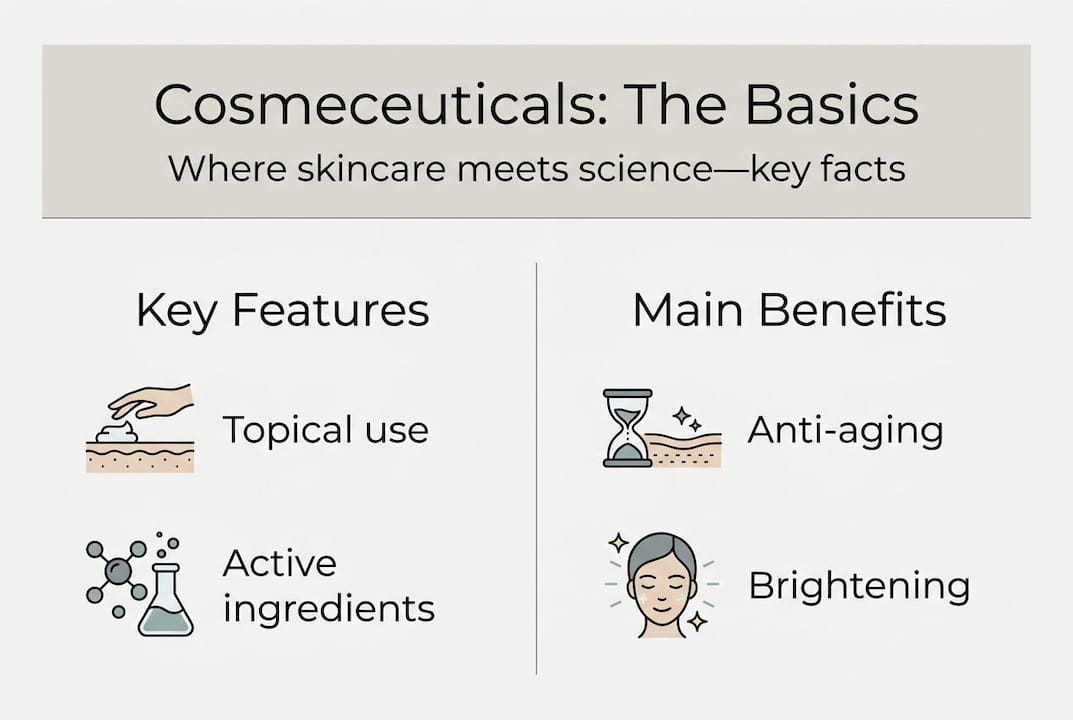
Here’s a quick side-by-side comparison to clarify where each category stands:
| Category | Primary purpose | Regulatory status | Example claims |
|---|---|---|---|
| Cosmetics | Beautify, cleanse, alter appearance | FDA regulated, not approved | “Moisturizes skin” |
| Drugs | Treat or prevent disease | FDA approved, pre-market review | “Treats acne” |
| Cosmeceuticals | Active skin benefits beyond appearance | Not legally recognized | “Reduces appearance of wrinkles” |
The key distinction is intent and effect. A lipstick colors your lips. A drug treats a condition. A cosmeceutical sits in between, claiming to actively improve skin health through ingredients like retinoids, peptides, or antioxidants.
Why does the term exist at all? Largely because the beauty industry needed a way to signal that certain products are more than basic moisturizers. Brands use “cosmeceutical” to imply clinical credibility and justify premium pricing. It’s a marketing tool as much as a scientific category.
Here’s what the cosmeceutical landscape looks like in terms of common product types:
- Anti-aging serums with retinol or peptides
- Brightening treatments with vitamin C or kojic acid
- Exfoliating products with AHAs (alpha hydroxy acids) or BHAs (beta hydroxy acids)
- Barrier repair creams with ceramides or niacinamide
- Sunscreens with added actives like antioxidants or growth factors
The global cosmeceuticals market was valued over $50 billion and continues to grow rapidly, driven by consumer demand for products that deliver visible, measurable results. That growth is real. But so is the confusion around what these products can legally claim to do.
Legal and regulatory status: Why the FDA doesn’t recognize cosmeceuticals
Here’s the twist most shoppers don’t know: in the United States, cosmeceuticals don’t legally exist.
“There is no legal category for cosmeceuticals. A product is either a cosmetic or a drug, and the law treats them very differently.” This is the FDA’s consistent position, and it has major implications for what brands can say on packaging.
The term “cosmeceutical” is not recognized by the FDA or any legal regulatory body. Products are classified strictly as cosmetics, drugs, or both based on their claims and intended use. No in-between.
So how does the FDA decide which is which? It comes down to language. Cosmetics are defined under the FD&C Act as articles for cleansing, beautifying, or altering appearance without affecting body structure or function. The moment a product claims to affect structure or function, or treat a disease, it becomes a drug and faces a completely different level of scrutiny.
Here’s how the legal distinctions break down in practice:
| Factor | Cosmetic | Drug | Cosmeceutical |
|---|---|---|---|
| FDA pre-market approval | Not required | Required | Not applicable |
| Ingredient safety burden | Manufacturer’s responsibility | Rigorous clinical trials | Manufacturer’s responsibility |
| Claim type allowed | Appearance only | Structure/function, disease | Appearance (legally) |
| Consumer protection level | Moderate | High | Moderate |
For you as a shopper, this regulatory gap has real consequences. Brands can use the word “cosmeceutical” freely without any oversight. A product labeled as such hasn’t necessarily been tested to drug standards. That doesn’t mean it doesn’t work. It means you can’t rely on the label alone.
When shopping by skin concern, keep these consumer takeaways in mind:
- Read ingredient lists, not just marketing claims
- Watch for drug-like language (“treats,” “cures,” “prevents disease”) on non-drug products
- Understand that “clinically tested” doesn’t mean FDA approved
- Seek out brands that share actual study data, not just before-and-after photos
- Be skeptical of proprietary blends that hide active concentrations
Popular cosmeceutical ingredients and their proven benefits
Despite the regulatory gray area, the science behind specific cosmeceutical ingredients is genuinely solid. Dermatologist consensus00612-7/abstract) recommends cosmeceutical-like ingredients including retinoids, vitamin C, niacinamide, and AHAs/BHAs for fine lines, acne, dark spots, and more, indicating real clinical utility.
Here are the five most evidence-backed actives and what they actually do:
-
Retinoids (retinol, retinal, tretinoin): The gold standard for anti-aging. Retinoids speed up cell turnover, stimulate collagen production, and reduce the appearance of fine lines. Prescription-strength tretinoin is a drug. Over-the-counter retinol is a cosmetic. Both work, but at different speeds and strengths.
-
Vitamin C (ascorbic acid): A powerful antioxidant that brightens skin, fades dark spots, and protects against UV-related damage. Learn more about vitamin C in skincare to understand which forms are most stable and effective.
-
Niacinamide (vitamin B3): One of the most versatile actives available. It reduces redness, minimizes pores, strengthens the skin barrier, and evens skin tone. Explore the full niacinamide benefits guide for a deeper look.
-
AHAs and BHAs (glycolic acid, lactic acid, salicylic acid): Chemical exfoliants that dissolve dead skin cells, unclog pores, and improve texture. AHAs work on the surface; BHAs penetrate deeper into pores, making them ideal for acne-prone skin.
-
Peptides: Short chains of amino acids that signal skin to produce more collagen. The research is promising, though results are slower and subtler than retinoids.
Many cosmeceuticals demonstrate empirical benefits in studies, including retinoids for wrinkles and antioxidants for photoaging, bridging cosmetics and pharma for proactive skin health.
For a broader look at how these ingredients work together, the guide on antioxidants in skincare is worth reading.
Pro Tip: When trying a new active ingredient, introduce it once or twice a week before building to daily use. Your skin needs time to adjust, and starting slow dramatically reduces the risk of irritation or purging.
How to choose and safely use cosmeceuticals: Smart consumer strategies
Knowing which ingredients work is only half the equation. The other half is knowing how to buy and use these products without wasting money or damaging your skin.
Products with high active concentrations risk irritation or regulatory scrutiny. Starting low and patch testing is the safest approach, especially with retinoids and acids.
Here’s a practical checklist for choosing a trustworthy cosmeceutical product:
- Check the active ingredient and its percentage. Effective retinol products typically list 0.1% to 1%. Vitamin C serums work best between 10% and 20%. If a brand hides concentrations behind “proprietary blend” language, that’s a red flag.
- Match the product to your specific concern. Don’t buy a retinol serum just because it’s popular. If your main concern is uneven tone, vitamin C or niacinamide may serve you better.
- Research the claims. If a product says it “reverses aging” or “eliminates wrinkles,” that language crosses into drug territory. Legitimate cosmeceutical-style products say “reduces the appearance of” wrinkles.
- Patch test before full application. Apply a small amount to your inner arm or behind your ear for 24 to 48 hours before using it on your face.
- Layer products in the right order. Actives like acids and vitamin C go on clean skin before heavier moisturizers. Following a basic skincare workflow prevents ingredient conflicts.
For those building a complete routine, the global skincare routine guide walks through how to sequence products for maximum results without overloading your skin.
Pro Tip: Look for products that reference peer-reviewed studies or have been developed with dermatologist input. This doesn’t guarantee results, but it signals the brand is held to a higher standard than pure marketing.
Avoid the trap of layering too many actives at once. Combining retinol with high-strength acids, for example, can strip your barrier and cause more harm than good. Simplicity and consistency beat complexity every time.
A fresh perspective: The real value and risks of cosmeceuticals
Here’s what most skincare content won’t tell you directly: the word “cosmeceutical” on a label means almost nothing on its own. It’s a marketing term dressed up in scientific clothing. What matters is the ingredient list, the concentrations, and whether the formulation has actual research behind it.
The beauty industry has done a remarkable job convincing consumers that more sophisticated language equals better results. It doesn’t. A well-formulated drugstore moisturizer with 0.5% retinol can outperform a luxury “cosmeceutical” serum with vague peptide claims and no published data.
Products that make drug-like claims such as “reduces wrinkles” versus “improves appearance of wrinkles” can be reclassified as drugs requiring stricter oversight. That distinction matters because it tells you how far a brand is willing to push its claims beyond what the science supports.
Our honest take: cosmeceuticals represent a genuinely useful category of skincare when you focus on evidence-backed ingredients and ignore the branding. Retinoids work. Vitamin C works. Niacinamide works. The science is there. But no single product will transform your skin overnight, and consistency over months matters far more than which brand you choose. Approach cosmeceuticals as tools, not miracles, and you’ll get real results.
Find proven cosmeceutical solutions with Skin Styles
You now have the knowledge to cut through the noise and make smarter choices. The next step is finding products that actually back up their claims.

At Skin Styles, we curate skincare products with active ingredients you can trust. Whether you’re looking for targeted facial creams and gels formulated with proven actives, or exploring dedicated anti-wrinkle solutions backed by dermatologist-recommended ingredients, our collection is built around real results. Browse by concern, compare formulations, and shop with the confidence that comes from understanding exactly what you’re putting on your skin.
Frequently asked questions
Are cosmeceuticals regulated or approved by the FDA?
The term “cosmeceutical” is not recognized by the FDA or any legal regulatory body. Products are classified as cosmetics or drugs based on their claims, not their ingredients.
Which cosmeceutical ingredients are most effective for anti-aging?
Retinoids, vitamin C, niacinamide, and AHAs are the most supported by evidence. Dermatologist consensus00612-7/abstract) recommends these actives specifically for fine lines, dark spots, and photoaging.
Can cosmeceuticals cause skin irritation?
Yes, especially products with high concentrations of retinoids or acids. Starting with low concentrations and patch testing before regular use significantly reduces that risk.
How can I try cosmeceuticals safely for the first time?
Read the ingredient label carefully, choose a low concentration to start, patch test for 24 to 48 hours, and look for products with dermatologist-recommended formulations rather than relying on marketing claims alone.