

TL;DR:
- Feeding milestones are developmental skills that indicate a child’s readiness for each stage of eating, not just age. Recognizing cues like head control and interest in food helps parents support safe and confident self-feeding. Using appropriate tools and routines tailored to developmental stages promotes successful, low-stress mealtime experiences.
Many parents assume that once their baby hits a certain birthday, they are automatically ready for the next stage of eating. That assumption leads to a lot of unnecessary worry. A feeding milestone is a developmental checkpoint where a child gains a specific feeding-related skill, and those skills follow a pattern tied to readiness, not just the calendar. Understanding this distinction helps you follow your child’s actual pace, reduce mealtime stress, and make smarter choices about the tools and routines you use along the way.
Table of Contents
- What are feeding milestones?
- Key feeding milestones: ages and stages
- Understanding cues: Signs your child is ready for the next milestone
- Practical tools: Accessories and routines that support feeding milestones
- When feeding milestones don’t progress: What’s normal vs. a sign to seek help
- Why skill-based feeding milestones matter more than age or portion size
- Support successful feeding milestones with the right essentials
- Frequently asked questions
Key Takeaways
| Point | Details |
|---|---|
| Skills-based progression | Feeding milestones are about new skills, not just age or amounts eaten. |
| Readiness cues matter | Watching for signs your child is ready is more useful than following a schedule. |
| The right tools help | Accessories and routines tailored to your child’s stage support safe skill development. |
| Seek help when needed | If mealtimes are stressful or milestones stall, consult a pediatrician. |
What are feeding milestones?
Feeding milestones are the specific abilities a child develops that allow them to safely and successfully eat at each stage of life. Think of them as building blocks. Each new skill relies on the ones that came before it, just like learning to walk requires balance before it requires stride.
According to research, a feeding milestone marks skill acquisition in an infant or young child, not simply an age bracket on a chart. This means a baby who turned six months old last week but still shows a strong tongue-thrust reflex (the automatic pushing out of food with the tongue) is simply not ready for solids yet, regardless of what the calendar says.
Why does this matter so much? Because pushing a child before they are ready can lead to gagging, food refusal, negative associations with mealtimes, and even safety concerns. You can monitor feeding milestones as part of a regular developmental check-in, giving you a clearer picture of where your child is and where they are heading.
Here is a quick look at the three categories feeding milestones fall into:
- Motor skills: Sitting upright, holding a spoon, bringing food to the mouth
- Oral motor skills: Chewing, mashing food with the tongue, swallowing safely
- Social and cognitive skills: Showing interest in food, responding to hunger and fullness, imitating eating behaviors
| Milestone type | What it involves | Why it matters |
|---|---|---|
| Motor | Sitting with support, grasping utensils | Safety and posture during meals |
| Oral motor | Tongue control, chewing, swallowing | Prevents choking, supports nutrition |
| Social/cognitive | Interest in food, hunger cues | Builds lifelong eating behaviors |
A critical point: milestones are not about how much a child eats. A baby who takes two bites of puree and then turns away is not failing a milestone. They are practicing it.
With that foundational understanding, let’s break down what feeding milestones look like at different ages and stages.
Key feeding milestones: ages and stages
Knowing the broad timeline of milestones helps you plan, prepare, and stay calm when things feel slow. The ranges below are typical, but your child’s pediatrician is always the best resource for individualized guidance.
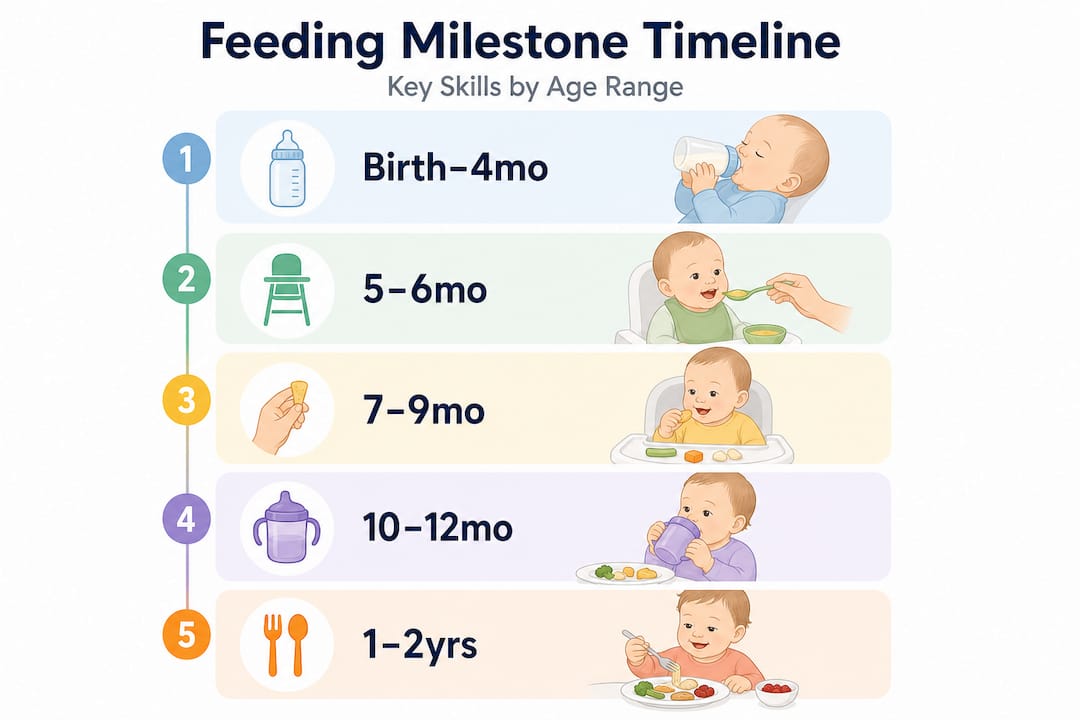
| Age range | Key milestone | What to look for |
|---|---|---|
| Birth to 4 months | Breastfeeding or bottle feeding | Strong suck/swallow reflex |
| 4 to 6 months | Pre-solids readiness | Head control, interest in food, reduced tongue thrust |
| Around 6 months | Starting pureed solids | Sitting with support, loss of tongue-thrust reflex |
| 7 to 9 months | Textured and mashed foods | Lateral tongue movement, mashing with gums |
| 9 to 12 months | Finger foods and cup introduction | Pincer grasp, cup interest |
| 12 to 18 months | Self-feeding with a spoon | Elbow and wrist control, scooping motion |
| 18 to 24 months | Family foods, varied textures | Molar eruption, improved chewing |
The CDC notes that for the first 6 months, babies are not ready for solid foods, water, or other drinks. Breast milk or formula alone meets all of their nutritional needs during that window. Offering solids too early does not speed up development; it introduces unnecessary risks.
Starting solid foods is one of the most anticipated milestones for parents, but it is also one of the most commonly rushed. Readiness for solids involves multiple skills converging at once, not just reaching a specific week.
Here is a numbered breakdown of the readiness checklist before introducing first foods:
- Baby can hold their head steady and sit upright with minimal support
- Baby shows genuine interest in food (watching others eat, leaning forward, opening mouth)
- Baby has lost or significantly reduced the tongue-thrust reflex
- Baby can move food to the back of the mouth and attempt to swallow
Pro Tip: Start with single-ingredient purees and wait two to three days before introducing a new food. This makes it far easier to identify any allergies or sensitivities early.
Building solid feeding routines alongside these milestones gives children the predictability they need to feel safe and confident at the table. And when it comes to actually practicing new skills, choosing the right feeding spoons for milestone skills can make a real difference in how quickly and enjoyably your child masters self-feeding.
Now that you know the major milestones, it is essential to understand how to recognize the cues that signal your child is ready for the next step.
Understanding cues: Signs your child is ready for the next milestone
Readiness cues are the behaviors your child shows you before they can use words to say “I am ready for something new.” Learning to read these cues is one of the most valuable feeding skills a parent can develop.
Caregivers use feeding milestones to judge readiness and safe participation in eating, including recognizing hunger and fullness signals. This means your role is not just to offer food but to observe and respond to what your child is communicating.
Common readiness cues to watch for include:
- Physical readiness: Sitting with support, steady head control, reaching toward food or utensils
- Oral readiness: Mouthing toys or objects, reduced tongue thrust, attempting to chew
- Behavioral readiness: Watching others eat with intense interest, opening mouth when food approaches, leaning forward in the high chair
- Satiety cues: Turning the head away, closing the mouth, pushing food away, losing interest in eating
“Responsive feeding is a reciprocal, dynamic process focused on reading hunger and satiety cues to support healthy skill development in young children.” Responsive Feeding and Child Feeding Practices
Responsive feeding means you are not on a rigid schedule where the baby must eat a set amount at a set time. Instead, you offer food at appropriate intervals and let your child guide how much they take. This approach builds trust and helps children develop a natural, healthy relationship with food from the very beginning.
A child who turns away after a few bites is not being difficult. They are communicating fullness. Honoring that signal at six months builds the habit of listening to their body, which pays off enormously in later years. Learning about choosing safe baby utensils is one practical step that supports this approach by ensuring the tools you use match where your child actually is in their development.
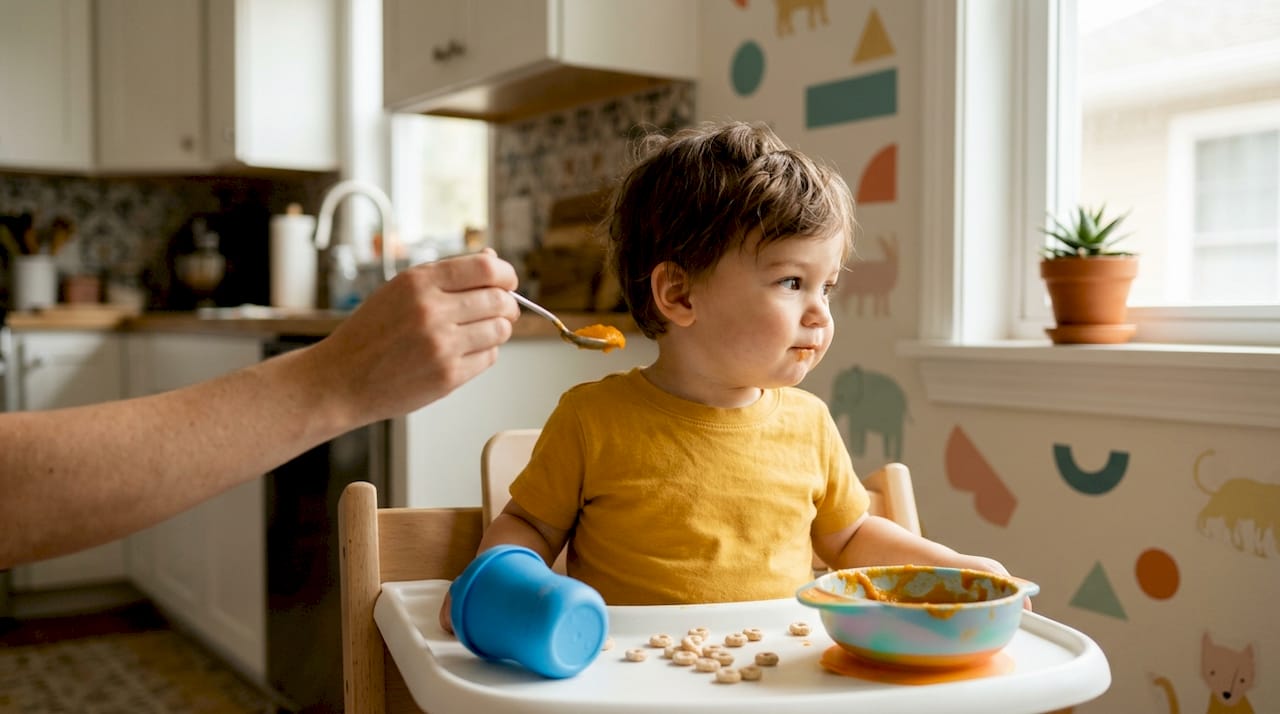
Recognizing cues is only part of the story. Using the right tools and approaches makes a big difference in safe, successful transitions.
Practical tools: Accessories and routines that support feeding milestones
The right feeding accessories do more than make meals less messy. They are designed to match where your child is developmentally, giving them a safe way to practice emerging skills.
Pick accessories based on developmental stage and safety, not on portion targets or what other children the same age are using. A soft-tipped spoon that is gentle on gums serves a very different function than a toddler spoon with a wide handle designed for small fists.
Here is how common accessories align with specific milestones:
- Soft silicone spoons: Perfect for the first pureed foods stage, gentle on emerging gums, and easy for caregivers to control during initial spoon-feeding
- Pre-spoon feeders or self-feeding spoons: Supports the 12 to 18-month self-feeding milestone, with short handles that match a toddler’s grip development
- Suction plates and bowls: Prevent frustrating food launches off the table, letting toddlers focus on the act of eating rather than chasing their dish
- Silicone bibs with a food catcher: Reduce cleanup anxiety so you feel more relaxed during messy practice sessions, which in turn keeps the atmosphere positive
- Open cups and straw cups: Support the transition away from bottles, which typically becomes a milestone focus around 12 months
Routines matter just as much as tools. Eating at consistent times, in the same high chair, with familiar utensils removes a lot of the novelty that can distract or overwhelm young children. A predictable mealtime environment allows them to focus their energy on the actual skill they are practicing.
Pro Tip: Let your child hold a spoon during spoon-feeding even before they can use it independently. Holding the spoon while you guide another spoon to their mouth builds familiarity and comfort with the utensil long before they are ready to self-feed.
When you choose baby feeding accessories with development in mind, you are essentially creating a learning environment at the table. And a well-matched feeding spoons guide can help you understand exactly which style suits your child’s current stage.
Occasionally, progress does not go as expected. It is important to understand when to seek extra help.
When feeding milestones don’t progress: What’s normal vs. a sign to seek help
Not every child moves through milestones at the same pace, and brief pauses or regressions are completely normal. A child who happily ate purees last week and now refuses them this week is probably just going through a developmental phase, teething, or reacting to a new environment. That kind of short-term refusal is not a red flag.
However, certain patterns deserve a closer look. When expected progression does not happen, clinicians look beyond ordinary picky eating and consider feeding disorders, which are a distinct clinical category requiring evaluation and support.
Signs that warrant a conversation with your child’s pediatrician or a feeding specialist include:
- Persistent food refusal lasting several weeks and affecting growth
- Significant weight loss or poor weight gain associated with feeding difficulties
- Extreme gagging, choking, or vomiting at most meals
- High distress at mealtimes in both the child and caregiver
- No progression in textures after several months at the same stage
- Loss of a previously mastered skill, such as no longer being willing to self-feed after achieving it
“Feeding disorders are not just about what a child eats. They involve disruptions in the relationship between caregiver and child around feeding, and can affect growth, development, and emotional wellbeing.” Feeding Disorders in Children
Keeping a simple mealtime journal is genuinely useful here. Note what foods were offered, what was accepted or refused, any notable reactions, and your child’s general mood during meals. Even two weeks of notes gives a clinician far better information than a recalled estimate. You can also monitor milestone progression with a structured tracking approach so patterns become visible over time.
Having explored the foundations and common challenges, let’s step back with a perspective that many parents find genuinely reassuring.
Why skill-based feeding milestones matter more than age or portion size
Here is the honest truth most feeding guides skip: rigid focus on age and portion size creates anxious mealtimes. And anxious mealtimes create anxious eaters. The research and the real-world experience of feeding specialists both point in the same direction. What builds a capable, confident eater is consistent, low-pressure skill practice, not hitting a chart checkmark on time.
When you watch a toddler joyfully smash avocado with a spoon and mostly miss their mouth, that is not failure. That is exactly what successful milestone work looks like. The mess is the practice. The miss is the motor learning. Expecting a clean, efficient result before the skill is developed is like expecting a child to ride a bike flawlessly on day one.
The most resilient eaters we see are children whose caregivers honored two things: their child’s pace and their child’s autonomy. Offering a variety of textures and flavors within a child’s current skill range, without pressure to finish a portion, builds self-regulation around food that lasts well into adulthood. It is a genuinely different outcome from the stress-feeding cycle that happens when adults become fixated on how many tablespoons went in.
The other underrated factor is tools. Offering a six-month-old food on an adult spoon that does not fit their mouth, or offering a toddler a full bowl of food with no suction base so it slides off the table, turns skills practice into frustration. Matching the accessory to the stage is not a marketing idea. It is developmental logic. You can see how real-life self-feeding stories reflect this principle in action.
Focus on what your child can do this week. Then build on it next week. That is the whole game.
Support successful feeding milestones with the right essentials
Every milestone your child reaches at the table is an opportunity to give them the right support and the right tools to practice confidently.

At Skin-Styles.com, we have curated feeding accessories specifically designed to meet children at each developmental stage. If you are ready to set up your child for mealtime success, our baby feeding essentials set includes BPA-free silicone suction plates, bowls, and a bib, giving toddlers everything they need to practice self-feeding safely. Each piece is sized and designed with skill development in mind, so you can stop worrying about the mess and start enjoying the milestone moments.
Frequently asked questions
What is considered a feeding milestone for babies?
A feeding milestone is a developmental checkpoint where a baby gains a new skill such as starting solids, using a spoon, or drinking from a cup, signaling they are ready to advance in their eating journey.
How do I know my baby is ready for solids?
Your baby is ready when they can sit with good support, show interest in food, and have lost the tongue-thrust reflex. Starting solid foods requires multiple readiness signs together, not just reaching a birthday.
What should I do if my child refuses to eat or has trouble with feeding milestones?
Track the pattern over time, and if struggles persist or mealtimes are very stressful, talk to your pediatrician. Clinicians consider feeding disorders when expected progression consistently does not happen.
Are feeding milestones based strictly on a child’s age?
No, milestones are based on developmental skills and individual readiness. Feeding milestones vary based on each child’s skill trajectory, making observation of readiness cues far more reliable than the calendar alone.