

TL;DR:
- Squalane is a stable, hydrogenated form of squalene, a skin lipid, offering longer shelf life and better oxidation resistance in products. It effectively moisturizes, supports the skin barrier, and suits most skin types due to its gentle, bio-identical profile. Proper layering after water-based serums enhances absorption, making squalane a versatile and underrated skincare ingredient.
You’ve probably spotted both “squalene” and “squalane” on skincare labels and wondered if someone made a typo. They haven’t. These two ingredients are closely related but behave very differently once they’re in your product. Squalane is the stabilized, hydrogenated form of squalene, a lipid your skin already produces naturally. That single chemical difference changes everything about how it performs in a formula, how long it lasts on the shelf, and why dermatologists reach for it again and again when formulating gentle, effective products.
Table of Contents
- What is squalane and how does it differ from squalene?
- Why squalane matters: Benefits for your skin
- How squalane works in routine: Application tips and compatibility
- Scientific evidence: What studies reveal about squalane and skin health
- Why squalane’s simplicity is its real superpower—what most beauty guides won’t tell you
- Upgrade your skincare routine with squalane essentials
- Frequently asked questions
Key Takeaways
| Point | Details |
|---|---|
| Squalane’s stability | Squalane is a hydrogenated, stable skincare oil that resists oxidation and lasts longer in your routine. |
| Moisturizing and barrier benefits | It deeply moisturizes, softens skin, and supports your skin barrier without clogging pores. |
| Universal compatibility | Squalane works for all skin types—including sensitive and acne-prone—and fits in most routines. |
| Science-backed effects | Research shows squalane helps fend off UV stress, supports wound healing, and preserves collagen. |
| Simple daily use | Apply squalane after water-based steps and pair with oils or creams for best results. |
What is squalane and how does it differ from squalene?
Now that the confusion is addressed, let’s unpack exactly what squalane is and why stability is so important in your skincare products.
Squalene is a naturally occurring lipid found in human sebum, the oily substance your skin produces to stay moisturized and protected. Your body makes it, plants make it (olives, sugarcane, amaranth seeds), and sharks store massive amounts in their livers. The problem with squalene in skincare is that it oxidizes quickly when exposed to air. Oxidized oils can irritate skin, clog pores, and shorten a product’s useful life significantly.
That’s where squalane steps in. The hydrogenation process adds hydrogen atoms to squalene’s double bonds, creating a molecule that is far more resistant to oxidation. The result is an ingredient that maintains its efficacy for a much longer shelf life and sits comfortably in formulas without going rancid. Squalane is used because it is more stable than squalene and delivers that longevity in finished skincare products.
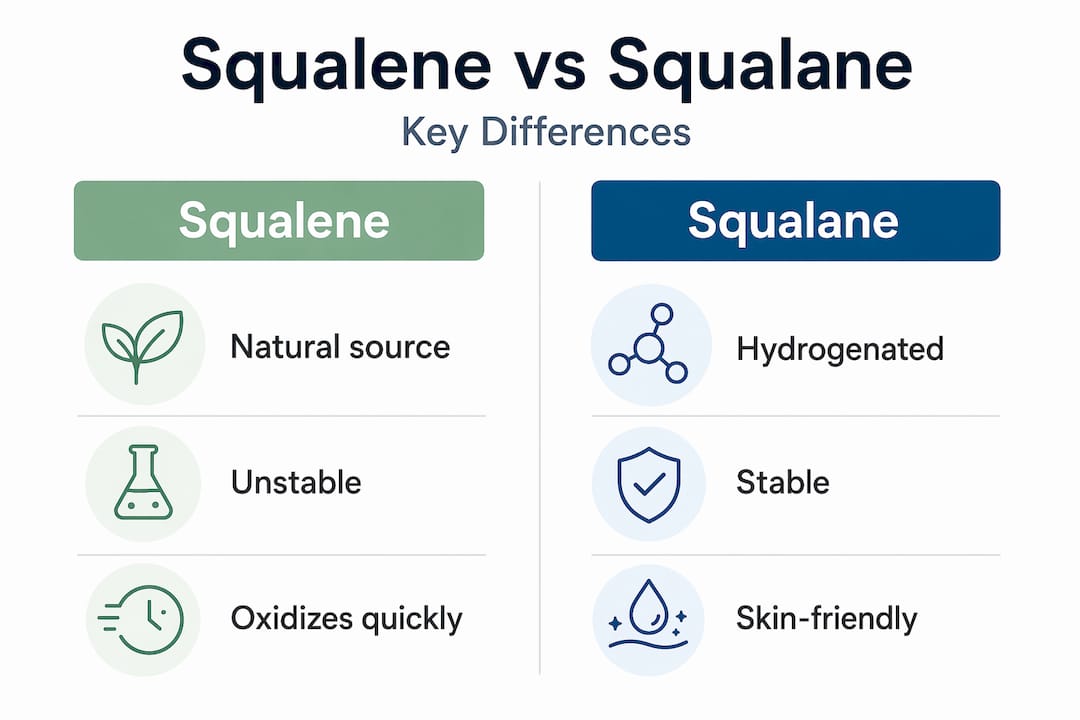
| Feature | Squalene | Squalane |
|---|---|---|
| Source | Shark liver, olives, sugarcane | Derived from squalene via hydrogenation |
| Stability | Prone to oxidation | Highly stable, resists oxidation |
| Shelf life | Shorter | Longer |
| Use in skincare | Rare in finished products | Widely used in serums, oils, creams |
| Skin origin | Natural component of human sebum | Bio-identical but more chemically stable |
Today, most squalane used in cosmetics is plant-derived, with sugarcane as the most popular sustainable source. This shift away from shark-derived squalene is a significant win for both consumers and marine ecosystems. When you pick up a bottle labeled “plant-based squalane,” it almost certainly comes from sugarcane fermentation, which produces a product chemically identical to skin-friendly squalene but in a far more stable form.
Here’s a quick look at what makes squalane stand out at the ingredient level:
- Lightweight texture with a non-greasy finish
- Colorless and odorless, making it easy to blend into any formula
- Suitable for most climates because its stability holds up in heat and humidity
- Vegan options readily available through plant-based sourcing
“Hydrogenation is a relatively simple process, but in formulation terms it’s transformative. Squalane brings all the emollient richness of squalene without the oxidative instability that would make a product degrade on the shelf or on your face.”
Why squalane matters: Benefits for your skin
With a clear science foundation, it’s easy to see why squalane is now a must-have oil. Let’s look at the benefits you actually feel and why skin experts trust it.

Squalane is primarily an emollient. That means it softens and smooths your skin by filling in the microscopic gaps between surface skin cells. Beyond that softening action, it contributes a mild occlusive effect, meaning it forms a light barrier on the skin’s surface that helps reduce transepidermal water loss (TEWL). Less water escaping means skin stays plumper and more comfortable for longer after application.
The benefits go well beyond basic hydration:
- Moisturizing: Reduces water loss and keeps skin feeling soft and supple throughout the day
- Barrier support: Reinforces the skin’s natural lipid barrier, which is especially valuable in cold or dry climates
- Softening and smoothing: Visibly improves texture with regular use
- Antioxidant support: Emerging research suggests it may help neutralize free radical activity
- Non-comedogenic: Does not clog pores, even on oily or acne-prone skin
- Anti-inflammatory potential: Gentle enough to calm reactive and sensitive skin
One reason dermatologists recommend squalane so freely is its bio-identical nature. Because squalane is non-comedogenic and bio-identical to skin lipids, it is recognized by skin as a familiar molecule rather than a foreign substance. This means it integrates well, causes minimal irritation, and rarely triggers breakouts. People with sensitive, oily, combination, and normal skin types report consistent positive results.
If you want to understand how squalane fits alongside other oils in your routine, our guide on types of facial oils breaks down which oils suit different skin concerns. For those managing reactive or easily irritated skin, the sensitive skin care tips resource also covers ingredient compatibility in more depth.
“Squalane is one of the few oils I feel comfortable recommending across the board. It’s light, stable, and genuinely well-tolerated. Most of my patients see improvement in skin softness and barrier function within two to three weeks of consistent use.”
Pro Tip: Layer squalane directly after your water-based serum while your skin is still slightly damp. The moisture you’ve just applied gets locked in more effectively, and squalane absorbs faster against slightly hydrated skin. You’ll avoid the dreaded pilling that sometimes happens when oil goes over a fully dried-down serum.
How squalane works in routine: Application tips and compatibility
The benefits are powerful, but using squalane correctly can make or break your results. Here’s how to make squalane work for you.
The biggest mistake most people make with squalane is using it at the wrong point in their routine. Because it’s an oil, it needs to go in the right layer to actually absorb and do its job. Here’s a reliable step-by-step order that works for most routines:
- Cleanse your face thoroughly. If you’re using a double cleanse approach, our breakdown of double cleansing steps walks you through exactly how to do it without stripping your barrier.
- Apply any water-based toners or essences and allow them to absorb fully.
- Use your water-based serums (vitamin C, hyaluronic acid, niacinamide) and let them settle for 30 to 60 seconds.
- Apply squalane as your oil layer, pressing it gently into the skin with your palms rather than rubbing it across the surface.
- Seal with a moisturizer or face cream if your skin is very dry or if you’re in a low-humidity environment. For help picking the right moisturizer, check out these moisturizer selection tips.
- Finish with SPF in the morning, applied as the absolute last step.
One thing that trips people up is squalane’s incompatibility with water-based mists. Because oil and water don’t mix, applying a facial mist over a layer of squalane just beads up on the surface and doesn’t absorb. If you love face mists, use them before squalane, not after.
Common pitfalls to avoid:
- Applying too much. Two to three drops is usually plenty for the entire face. More product doesn’t mean better results, it just increases the chance of a greasy finish.
- Mixing squalane directly into a water-based serum in your hand. They won’t blend properly and you’ll dilute the effectiveness of both products.
- Skipping it in summer. Because squalane is so lightweight, it works year-round without feeling heavy, even in warm, humid weather.
Pro Tip: If you’re blending squalane with another facial oil (like rosehip or marula), mix them in the palm of your hand before applying. The warmth from your hands helps the oils blend and makes them spread more evenly across your face without over-saturating any one area.
Scientific evidence: What studies reveal about squalane and skin health
Knowing how to apply squalane is empowering, but what does the research actually reveal? Let’s decode the science and what it means for your results.
The clinical picture for squalane is building, and it’s genuinely encouraging. Recent laboratory and animal studies reveal that squalane does more than just moisturize. It appears to interact with skin at the cellular level in ways that may protect against some of the most common forms of skin damage.
| Study type | Model used | Key finding |
|---|---|---|
| In vitro (cell study) | Human dermal fibroblast cells | Squalane counteracted UVA-induced oxidative stress and inflammation pathways |
| In vitro (cell study) | Human dermal fibroblast cells | Improved wound-healing behavior in damaged cells |
| Animal model | Mouse photoaging model | Squalene oleogel reduced UVB-induced epidermal thickening and collagen degradation |
| Observational | General cosmetic formulations | Widely documented as emollient, barrier-supporting, and non-sensitizing |
The UVA study is particularly significant. Fibroblasts are the cells in your dermis responsible for producing collagen and elastin. When these cells are hit by UVA radiation, they enter an inflammatory and oxidative stress response that breaks down collagen over time, contributing directly to fine lines and sagging. The fact that squalane showed protective effects in these cells suggests it may play a supportive role in anti-aging routines, even though it isn’t a sunscreen.
The animal model research using a squalene oleogel adds another layer. Epidermal thickening and collagen degradation are two classic markers of photoaging, the kind of aging driven by sun exposure rather than the passage of time. Seeing reduced markers in UVB-exposed animals treated with squalene-based formulas hints at real-world skin protection benefits.
“In plain terms: the research suggests that squalane isn’t just sitting on the surface of your skin doing nothing. It appears to interact with skin cells in a way that may reduce some of the damage caused by UV exposure and environmental stress. It’s not a replacement for sunscreen, but it may give your skin extra resilience.”
It’s worth noting that most published studies use in vitro or animal models rather than large human clinical trials. The science is promising and directionally consistent, but it’s still maturing. What’s already well-established is squalane’s safety profile and its effectiveness as an emollient. The UV-protective and wound-healing data adds depth to why this ingredient deserves its reputation.
Why squalane’s simplicity is its real superpower—what most beauty guides won’t tell you
You’ve seen the science; now let’s get real about what’s often missed in the conversation around squalane.
The skincare industry has a habit of making complexity feel like value. New peptides, advanced delivery systems, and 12-step routines dominate headlines. Against that backdrop, squalane almost feels boring. One ingredient, simple mechanism, gentle results. But this is exactly why we think it’s one of the most underrated tools in any routine.
What we see consistently, both in research and in the feedback from real skincare users, is that complicated routines often introduce irritation, not results. The more ingredients you layer, the more chances you have for a reaction, for barrier disruption, or for product incompatibility. Squalane works precisely because it doesn’t demand much. It integrates with almost any skin type without negotiation. Whether your skin is oily and reactive, dry and tight, or somewhere in the middle, squalane tends to meet it where it is.
There’s also a consistency angle that rarely gets enough credit. The biggest visible improvements most people see in their skin come not from finding the most advanced product, but from using a gentle, effective one every single day without breaking. Squalane is the kind of ingredient you can apply morning and night without worrying about overuse, sensitivity flares, or seasonal adjustments.
For people who feel overwhelmed by ingredient-dense routines, we often suggest a “back-to-basics” reset. Strip it down to cleanser, squalane, and SPF for two weeks. For tips on building a simplified routine that actually works, our guide on sensitive skin comfort walks through exactly this kind of reset approach. The results usually surprise people.
Squalane’s real superpower isn’t its UV research or its hydrogenation chemistry. It’s the fact that it does meaningful work, consistently, on nearly every skin type, without asking anything complicated in return. In skincare, that’s rarer than it sounds.
Upgrade your skincare routine with squalane essentials
Ready to put your knowledge to work? Squalane shows up in some of the best performing hydration and anti-aging formulas available today, and knowing what to look for makes shopping a lot more purposeful.

At Skin-Styles.com, we’ve curated a selection of products designed for exactly the kind of thoughtful, ingredient-aware skincare that works. If you’re looking to build on what you’ve learned here, browsing our hydrating facial creams is a great starting point for finding squalane-infused moisturizers that lock in all the good work your routine is already doing. For those focused on long-term skin health and reducing visible signs of aging, our anti-aging solutions collection features formulas that pair squalane with complementary actives for layered, visible results. Your skin already knows what squalane is. Now it’s time to give it more.
Frequently asked questions
Is squalane safe for sensitive or acne-prone skin?
Squalane is well-tolerated and non-comedogenic, making it a strong choice for sensitive and acne-prone skin types because it closely mirrors the skin’s own lipids.
Can I use squalane with other actives like retinol or vitamin C?
Yes, squalane pairs well with most actives and actually helps offset dryness and irritation that retinol or vitamin C can sometimes cause with regular use.
What’s the best way to apply squalane?
Apply squalane after your water-based serums and before heavier creams, since squalane mixes best with oil-compatible steps rather than watery toners or mists.
Does squalane have sun protection properties?
Research shows squalane may help protect against UVA-induced oxidative stress at the cellular level, but it is not a sunscreen and does not replace daily SPF use.
Why do some products use squalane instead of squalene?
Squalane is the stabilized, hydrogenated form of squalene, giving it a longer shelf life and far greater resistance to oxidation, which makes it far more practical for finished skincare products.