

TL;DR:
- Hypoallergenic means less likely to cause an allergic reaction, not allergy-free or safety-certified.
- Products labeled hypoallergenic vary in testing, so ingredient transparency and patch testing are essential.
- Choosing formulations with barrier-supporting ingredients supports skin health and reduces irritation.
Why choose hypoallergenic: safe skincare for sensitive skin
If you’ve ever grabbed a product off the shelf because it said “hypoallergenic” and assumed you were safe, you’re not alone. Millions of people with sensitive or allergy-prone skin do exactly the same thing every day. But here’s what most brands won’t tell you: “hypoallergenic” is not regulated by the FDA or any equivalent body, which means any brand can slap that word on a label without meeting a single standardized safety test. This article breaks down what the term actually means, what the science says about its real benefits, and exactly how to shop smarter for your skin.
Table of Contents
- What does ‘hypoallergenic’ really mean?
- Why choose hypoallergenic products for sensitive or allergy-prone skin?
- How hypoallergenic skincare protects and repairs your skin barrier
- Tips for smart shopping: What to check before you buy
- The uncomfortable truth: Why ‘hypoallergenic’ is just the starting point
- Gentle solutions for your sensitive skin journey
- Frequently asked questions
Key Takeaways
| Point | Details |
|---|---|
| Unregulated term | Hypoallergenic labels are not legally defined and can vary widely between brands. |
| Clinically backed benefits | Hypoallergenic products offer measurable improvements in hydration and reduced irritation for sensitive skin. |
| Read labels carefully | Check ingredient lists, avoid common triggers, and prefer products with clinical testing evidence. |
| Barrier protection focus | These products support skin barrier function, aiding conditions like eczema and rosacea. |
| Patch test always | Even with hypoallergenic claims, always patch test to minimize unexpected reactions. |
What does ‘hypoallergenic’ really mean?
With the term ‘hypoallergenic’ so commonly found on skincare shelves, let’s get clear on what it truly means.
The word itself comes from Greek roots: “hypo” meaning less, and “allergenic” meaning likely to cause an allergic response. So technically, hypoallergenic means “less likely to cause an allergic reaction.” Not allergy-free. Not reaction-proof. Just less likely. That distinction matters enormously when you have skin that flares at the slightest provocation.
Here’s the hard truth: as the FDA confirms, the term is a marketing claim without any standardized testing requirements, and there is no legal definition governing its use. One brand’s hypoallergenic moisturizer might go through extensive clinical testing on sensitive skin volunteers. Another brand’s product with the same label might have undergone no special testing at all. The label tells you almost nothing about the rigor behind it.
This is why people with sensitive skin still experience reactions to products they trusted. The product wasn’t lying, exactly. It just wasn’t proving anything, either.
Common misconceptions to clear up right now:
- “Natural” does not mean non-allergenic. Lavender oil, tea tree oil, and citrus extracts are all natural and all common triggers for allergic contact dermatitis.
- “Hypoallergenic” does not mean the product contains zero allergens. It just implies fewer or lower-risk ones.
- No product can guarantee it won’t cause a reaction in every person, because sensitivities are individual.
- Fragrance-free and unscented are different. Unscented products may still contain masking fragrances that cause reactions.
So what should you actually do? Start with our sensitive skin care guide to build a solid foundation. Then, read every ingredient list. Look for products that clearly state they were clinically tested on sensitive skin volunteers, not just in a standard safety lab setting. And always, without exception, perform a patch test before applying anything new to your face or a large area of skin. Apply a small amount to your inner wrist or behind your ear and wait 24 to 48 hours before full use.
“The term ‘hypoallergenic’ is a marketing claim, not a safety certification. There are no FDA-required tests a product must pass before using this label.”
Understanding this reality doesn’t mean you should abandon hypoallergenic products entirely. It means you need to go one step further and look at what’s actually in the formula.
Why choose hypoallergenic products for sensitive or allergy-prone skin?
Once you know the reality behind the label, it’s important to understand why people still look for hypoallergenic options, and why doing so makes genuine sense.
Even without a regulated definition, well-formulated hypoallergenic products offer real advantages. The key is knowing that better brands do invest in additional testing beyond standard cosmetic safety assessments. As research published in clinical dermatology literature confirms, hypoallergenic products undergo rigorous testing on panels of sensitive skin individuals to confirm tolerability, going well beyond what typical cosmetics require.
The results from these studies are striking. A clinical review of gentle, hypoallergenic-style formulations for people with sensitive skin found significant, measurable improvements. One cleanser study involving 30 participants showed +42% hydration increase, a 28% reduction in transepidermal water loss (TEWL), 65% less dryness, and a 58% drop in reported irritation. In a moisturizer preclinical study within the same review, filaggrin levels (a key skin barrier protein) increased by 77%, hyaluronic acid production rose by 157%, and lipid content improved by 30%.
Those are not small gains. For someone living with daily redness, tightness, or persistent flaking, those numbers represent real relief.
Why hypoallergenic formulations tend to perform better for sensitive skin:
- They typically exclude the most common irritants (fragrances, synthetic dyes, harsh surfactants).
- They’re often formulated with fewer total ingredients, which reduces the number of potential triggers in a single product.
- Many go through consumer perception studies where participants report tolerability and comfort over time.
- They’re more likely to support rather than disrupt the skin barrier, which is often already compromised in sensitive skin conditions.
For those specifically managing sensitive skin alongside conditions like eczema or rosacea, hypoallergenic products offer a safer starting point compared to conventional cosmetics. They won’t fix everything, but they reduce the probability of a flare significantly.
Pro Tip: When browsing moisturizers, compare formulas and prioritize those that are both fragrance-free and contain five or fewer active ingredients. Shorter ingredient lists mean fewer variables when tracking down a trigger.
How hypoallergenic skincare protects and repairs your skin barrier
So what makes a hypoallergenic product potentially more protective for your skin?
The skin barrier, sometimes called the stratum corneum, is your body’s first line of defense against the environment. Think of it like a brick wall: skin cells are the bricks, and a mix of lipids including ceramides, cholesterol, and fatty acids form the mortar holding everything together. When that mortar weakens, the wall develops cracks. Moisture escapes. Irritants get in. Inflammatory reactions follow.

Hypoallergenic formulations are specifically designed to support this structure. Research shows that well-designed formulations mimic the natural lipid ratio of a healthy barrier (ceramides, cholesterol, and fatty acids in a 1:1:1 ratio), reduce TEWL, restore natural moisturizing factor (NMF) derived from filaggrin, and interrupt the itch-scratch-inflammatory cycles commonly seen in conditions like atopic dermatitis, eczema, and rosacea.
Key ingredients to look for and why they matter:
| Ingredient | Function | Why it matters for sensitive skin |
|---|---|---|
| Ceramides | Lipid replacement | Restores barrier integrity |
| Hyaluronic acid | Humectant | Attracts and retains moisture |
| Cholesterol | Barrier support | Works with ceramides to seal gaps |
| Niacinamide | Anti-inflammatory | Reduces redness and strengthens barrier |
| Glycerin | Humectant | Pulls water into upper skin layers |
| Allantoin | Soothing agent | Calms irritation and supports healing |
For conditions like eczema, rosacea, and contact dermatitis, choosing products with the right moisturizer formulation isn’t just a comfort choice. It’s a clinical strategy.
How to read an ingredient list for barrier support:
- Look for ceramides listed near the top of the INCI (International Nomenclature of Cosmetic Ingredients) list. Position indicates concentration.
- Check for “fragrance” or “parfum” anywhere in the list. If present, set the product down.
- Confirm the presence of at least one humectant such as glycerin or hyaluronic acid.
- Avoid products listing alcohol denat. (denatured alcohol) in the top ten ingredients, as it is highly drying.
- Search for calming agents like allantoin, bisabolol, or panthenol, which reduce reactive inflammation.
This five-step review process can be done in under two minutes in-store or online and dramatically improves your odds of choosing a product your skin will actually tolerate.
Tips for smart shopping: What to check before you buy
Armed with knowledge of the science, here’s how you can make confident choices while shopping.
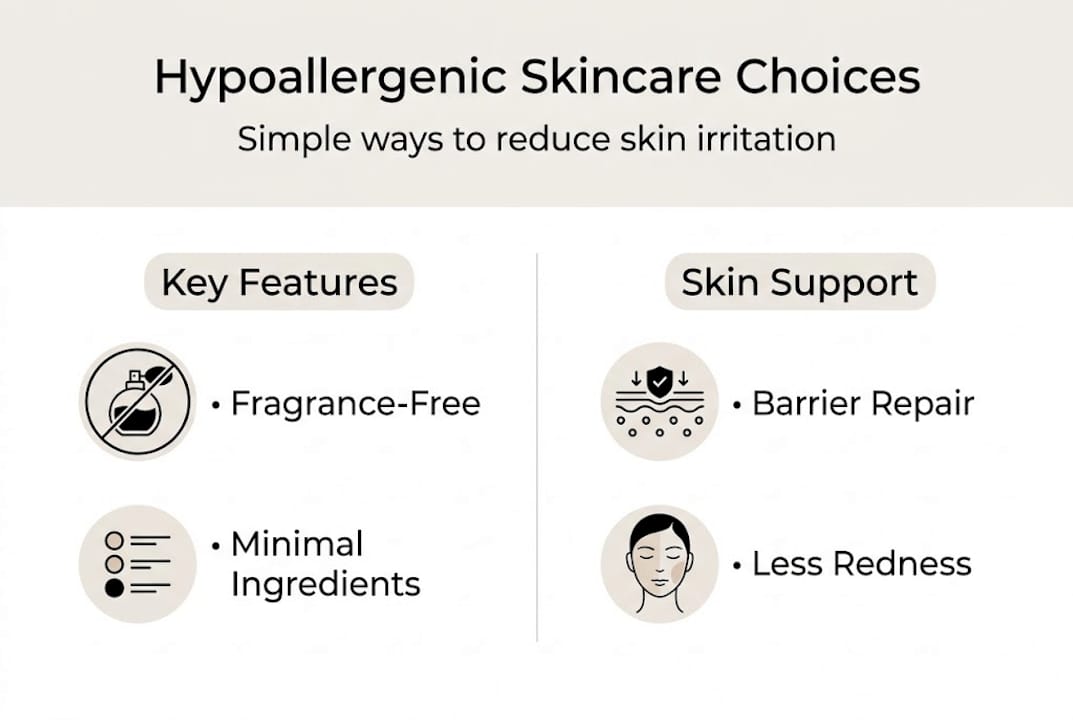
Being a smart shopper when you have sensitive skin is partly about knowledge and partly about slowing down. The biggest mistake most people make is relying on front-of-package claims rather than the actual ingredient list. Let’s change that habit.
Research confirms that fragrances are among the top causes of allergic contact dermatitis in cosmetics. And critically, this includes natural fragrances from essential oils. Rose, lavender, eucalyptus, peppermint, and citrus-derived compounds are all documented allergens that appear in products marketed as “clean” or “natural.” The word natural does not equal safe for sensitive skin. Remember that.
Smart shopping: What to check before buying any skincare product:
- Read the full INCI ingredient list, not just the front label claims.
- Search for the words “fragrance,” “parfum,” or “aroma” anywhere in the list and avoid those products.
- Look for explicit statements like “clinically tested on sensitive skin” backed by specific study references.
- Confirm the product is free of synthetic dyes (listed as FD&C or D&C followed by a color and number).
- Check for formaldehyde-releasing preservatives (DMDM hydantoin, imidazolidinyl urea, quaternium-15), which are common irritants even in small amounts.
For practical guidance tailored to your skin type, our allergy-friendly skincare tips resource covers real-world strategies for avoiding common triggers. And if cleansers are part of your routine, reviewing cleanser tips for sensitive skin can help you avoid the most common formulation mistakes.
Hypoallergenic vs. regular product comparison:
| Feature | Typical hypoallergenic product | Typical regular product |
|---|---|---|
| Fragrance | Usually absent | Commonly present |
| Ingredient count | Often shorter (fewer triggers) | Frequently longer |
| Sensitive skin testing | Often conducted | Rarely conducted |
| Dyes and colorants | Usually excluded | Often included for aesthetics |
| Clinical tolerability data | More commonly available | Less commonly available |
One note of caution about natural skincare: while we strongly support plant-based formulas, “natural” is not a synonym for safe. If you’re curious about the nuances, our guide on natural ingredients gives a balanced view.
Pro Tip: Before fully committing to any new skincare product, apply a small amount to your inner forearm for two nights in a row. If no reaction occurs, try it near your jawline. This two-stage patch test catches most contact reactions before they spread to more visible areas.
The uncomfortable truth: Why ‘hypoallergenic’ is just the starting point
With all the nuance layered into this topic, here’s what we genuinely believe after working with sensitive-skin consumers: the hypoallergenic label is useful, but it is not a finish line. It’s a door you walk through to begin asking better questions.
The skincare industry has a long history of letting marketing language do heavy lifting that science hasn’t earned. “Hypoallergenic,” “dermatologist-tested,” “suitable for sensitive skin.” These phrases create a sense of safety that isn’t always backed by rigorous data. Dermatologist-tested, for example, can simply mean one dermatologist looked at the formula and had no objections. That’s not a clinical trial.
The most empowered approach we’ve seen in practice is this: treat your skin as the only data point that actually matters. You might react to an ingredient that 98% of sensitive skin users tolerate perfectly. That doesn’t make your reaction wrong. It makes it yours. Start your search with the expert sensitive skin care guide to build real self-knowledge about your triggers, rather than relying on a label to make that determination for you.
Know your triggers. Patch test everything. Choose fragrance-free and minimal-ingredient formulas. Prioritize clinical evidence over creative packaging. That approach will serve you infinitely better than any single label ever will.
Gentle solutions for your sensitive skin journey
Now that you understand how to evaluate hypoallergenic claims and read ingredient lists with confidence, finding products that genuinely meet those standards becomes the next step.

At Skin Styles, we curate a selection of skincare products chosen with sensitive and allergy-prone skin in mind. Whether you’re searching for barrier-supporting moisturizers or gentle cleansers, our hypoallergenic facial creams collection brings together formulas that prioritize tolerability and skin health. For fans of evidence-backed K-beauty formulations known for gentle, minimal-irritant ingredients, the Cosrx selection offers a strong starting point. Browse, compare ingredient lists, and use what you’ve learned here to choose with real confidence.
Frequently asked questions
Are hypoallergenic products completely safe for people with allergies?
No, hypoallergenic products are less likely to cause reactions, but they are not allergy-proof. Even a rigorously tested formula may still irritate highly reactive individuals, because no standard testing requirement exists to validate the label.
What ingredients should I avoid if I have sensitive skin?
Avoid fragrances, essential oils, synthetic dyes, and formaldehyde-releasing preservatives such as DMDM hydantoin. These are among the top causes of allergic contact dermatitis in cosmetic products.
How can I know if a hypoallergenic product is right for me?
Look for products with clinical testing on sensitive skin participants, full ingredient transparency, and perform a patch test before applying the product more broadly. Your own skin’s response is always the most reliable data.
Do hypoallergenic products help with skin conditions like eczema or rosacea?
Yes. By including barrier-repairing lipids and excluding common irritants, hypoallergenic formulations can actively support people with eczema or rosacea. Clinical evidence confirms they help restore barrier function and reduce inflammatory flare cycles.