

TL;DR:
- Dry, dull skin often results from a lack of understanding of how to effectively lock in moisture and support the skin barrier. Proper hydration involves applying humectants, emollients, and occlusives in a specific order to restore and maintain the skin’s moisture levels. Consistent, complete routines that address each key role lead to lasting improvements in skin health and comfort.
Dry, tight, or dull skin is one of the most common frustrations in skincare, yet most people are still guessing their way through it. You try layering more products, switching to a richer moisturizer, and drinking more water, but nothing seems to stick. The problem is rarely a lack of effort. It is a lack of clarity about how skin actually holds onto moisture, what ingredients do that job, and in what order they need to go on. This guide breaks down the complete skin hydration process from the biology of your skin barrier to exact application steps so you can stop guessing and start seeing real results.
Table of Contents
- What drives skin hydration? Key factors and ingredients
- Step-by-step: The optimal skin hydration process
- Measuring your progress: How to know if hydration is working
- Troubleshooting: Barriers to hydration in special situations
- What most skincare guides get wrong about skin hydration
- Upgrade your routine with proven hydration solutions
- Frequently asked questions
Key Takeaways
| Point | Details |
|---|---|
| Ingredient synergy | Optimal hydration requires humectants, occlusives, and emollients working together. |
| Combination matters | Layering products without barrier support can worsen dryness, not improve it. |
| Check real results | Look for changes in texture, plumpness, and comfort to confirm routine effectiveness. |
| Adapt for your needs | Adjust your skin hydration approach for aging skin or compromised barriers. |
What drives skin hydration? Key factors and ingredients
The outermost layer of your skin, called the stratum corneum (SC), acts like a brick-and-mortar wall. The “bricks” are dead skin cells, and the “mortar” is made up of lipids (fats) including ceramides, cholesterol, and fatty acids. This barrier has one critical job: keep water inside your skin and keep irritants out. When the mortar breaks down from cold weather, over-cleansing, aging, or harsh ingredients, water escapes rapidly. This water loss, called transepidermal water loss (TEWL), leaves skin looking flat, feeling tight, and prone to irritation.
Understanding this structure explains why not all moisturizers work the same. The top hydration ingredients on the market today work through three distinct functions, and each one targets a different part of the hydration problem.
The three core moisturizer ingredient types:
- Humectants: These molecules attract water from the environment and from deeper skin layers up into the stratum corneum. Common humectants include hyaluronic acid, glycerin, urea, and panthenol. Learning how humectants boost hydration helps you understand why they should always be applied to damp skin.
- Occlusives: These create a physical seal on the skin’s surface to slow down water evaporation. Ingredients like petrolatum, dimethicone, beeswax, and shea butter fall into this category. The science behind occlusives moisture lock shows they are most powerful when layered over humectants.
- Emollients: These fill in the microscopic gaps between skin cells, smoothing the surface and reinforcing the lipid matrix. Squalane, ceramides, and plant oils are classic emollients. Reviewing emollients vs humectants clarifies why both are essential and not interchangeable.
Research confirms that moisturizers improve hydration through these three complementary functions: humectants bind and draw water, occlusives reduce evaporation and TEWL, and emollients smooth and soften while supporting barrier lipids. No single ingredient type can do all three jobs on its own.
| Ingredient type | Primary action | Example ingredients |
|---|---|---|
| Humectant | Draws water into skin | Hyaluronic acid, glycerin, urea |
| Occlusive | Prevents water from escaping | Petrolatum, dimethicone, shea butter |
| Emollient | Smooths and repairs lipid gaps | Squalane, ceramides, plant oils |
Pro Tip: If you live in a very dry climate, humectants without an occlusive layer can actually pull moisture out of your deeper skin layers and into the air. Always seal.
Step-by-step: The optimal skin hydration process
Understanding what goes into good hydration, here’s how to practically apply these principles to your routine.
Effective hydration is not about using the most expensive product. It is about applying the right ingredients in the right sequence at the right time. Each step builds on the last, and skipping one can undermine the whole effort.
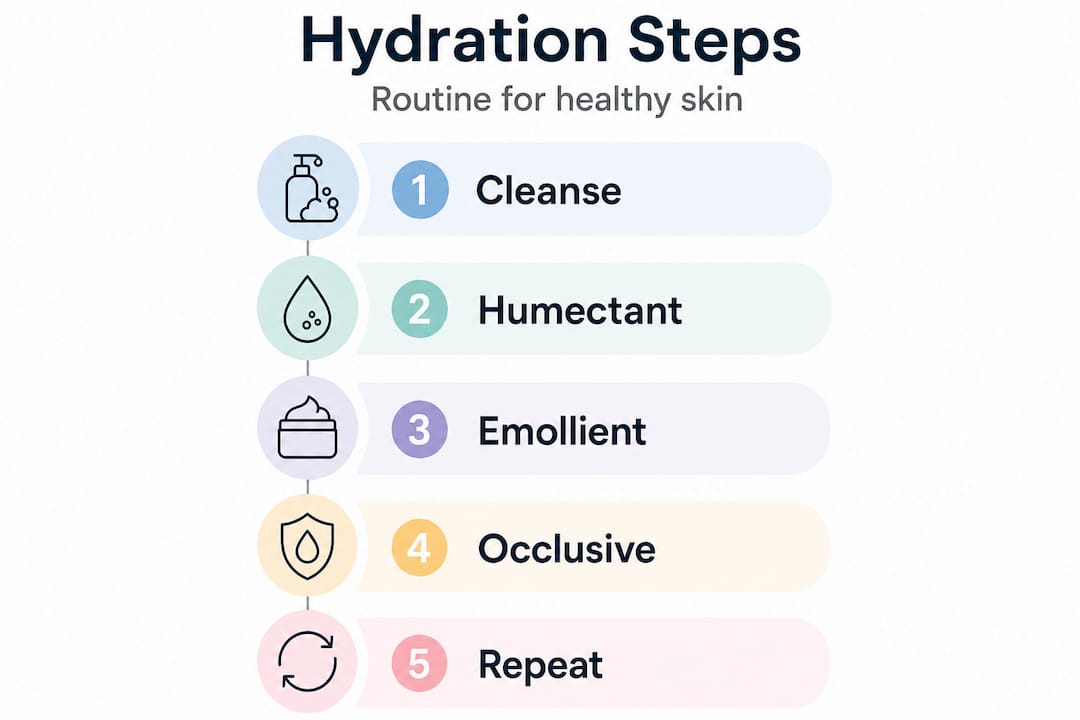
Step 1: Prepare with clean, damp skin
Start every hydration routine with a gentle, pH-balanced cleanser that does not strip your natural oils. Harsh surfactants damage the lipid matrix before you even start applying moisture. After cleansing, pat your face until it is just slightly damp, not soaking wet and not fully dry. That surface dampness gives humectants something to work with immediately.
Step 2: Apply your humectant serum
While skin is still damp, apply a serum rich in humectants like hyaluronic acid or glycerin. Press it gently into the skin using your fingertips rather than rubbing. This step floods the upper layers of the stratum corneum with water-binding molecules. Give it 30 to 60 seconds to absorb before moving on.
Step 3: Layer on your emollient
Apply a cream or lotion that contains emollient-rich ingredients such as ceramides, squalane, or fatty acids. This fills the lipid gaps in your skin barrier, making the surface feel smooth and helping the structure of the wall hold together. Good barrier repair for hydration is the step most people skip, and it is often the reason results feel inconsistent.
Step 4: Seal with an occlusive (especially at night)
During the day, a lightweight moisturizer with slight occlusive properties is enough. At night, you can go heavier. A balm, cream with petrolatum, or even a few drops of a denser oil locks everything in place while your skin does its overnight repair work. This is what beauty enthusiasts call “slugging” in its most intense form, but even a moderate occlusive layer makes a significant difference.
Step 5: Repeat with consistency
Twice daily application is the benchmark supported by clinical practice. Research shows that using a single humectant without barrier support can actually risk disrupting lipid organization and increase TEWL, underlining why the full layered routine matters for lasting results. Hydration is cumulative. One good application will not offset weeks of neglect.
| Routine step | Product type | Timing |
|---|---|---|
| Cleanse | Gentle, pH-balanced cleanser | Before all other steps |
| Humectant serum | Hyaluronic acid, glycerin | Damp skin, first |
| Emollient layer | Ceramide cream, squalane | After serum absorbs |
| Occlusive seal | Balm, dense moisturizer | Last step, especially at night |
Pro Tip: Apply your products within 60 seconds of washing your face. Once skin dries completely, you lose the dampness advantage that makes humectants work at full efficiency.
Measuring your progress: How to know if hydration is working
Once you’ve begun your hydration process, use these methods to check your progress.
One of the biggest traps in skincare is expecting overnight transformation. Visible improvements in hydration, including plumper texture, smoother surface, and fewer fine lines, develop over days and weeks, not hours. Knowing what to look for and when keeps you from abandoning a routine that is actually working.
At-home signs your hydration is improving:
- Skin feels comfortable and supple after cleansing (not tight or itchy)
- The surface looks less dull and has a natural, healthy glow
- Fine lines look softer, especially around the eyes and mouth
- Skin does not feel greasy, but it does not feel like it is pulling either
- Foundation and makeup apply more smoothly without flaking
From a clinical standpoint, measuring hydration properly involves noninvasive measurements such as corneometry for stratum corneum hydration and TEWL readings, with attention to standardized room conditions and device-specific protocols. Corneometers measure the electrical capacitance of the skin, which increases as water content rises. You probably do not have one at home, but dermatologists and skincare researchers use these devices to generate objective data.
What you do have access to is consistency. Measure your skin feel at the same time every morning, before applying anything. That baseline moment is your most honest signal.
“An emollient-rich moisturizer was clinically tested in people with moderate-to-severe dry, dehydrated skin and showed improvements in objective hydration measurements over 8 weeks with twice-daily use.”
That eight-week timeline is worth anchoring to. If you have been at it for only two weeks and see minor improvement, you are likely on track. The reasons why you should moisturize consistently become clear when you understand that barrier repair is a slow, biological process.
Warning signs that something is wrong:
- Persistent tightness despite regular application: this often means your formula lacks occlusives or has irritating ingredients
- New itching or redness: you may be reacting to a specific ingredient, often fragrance or certain preservatives
- Skin feels greasy but still looks dull: you are likely sealing with too much occlusive without enough humectant underneath
- Flakiness that does not resolve: your barrier may be too compromised for basic moisturizers alone, and a dermatologist visit is worth scheduling
Troubleshooting: Barriers to hydration in special situations
If your results aren’t matching expectations, consider these troubleshooting insights.
Even the most well-designed routine can fall short in certain situations. Knowing the specific variables that affect your skin type or life stage makes it far easier to adjust intelligently rather than overhauling your entire routine.
Age-related changes in hydration capacity
Skin naturally produces fewer ceramides, less natural moisturizing factor (NMF), and reduced sebum as you age. Research shows that in aging and barrier-compromised skin, the balance of bound water in the stratum corneum shifts, contributing to greater dryness and impaired hydration capacity. For mature skin, simply adding more hyaluronic acid serum will not be enough. You need to address the ceramide deficit with targeted emollient-rich products and potentially peptide-based formulas that support skin structure.
Common mistakes that sabotage hydration:
- Using only a humectant serum and skipping the moisturizer entirely
- Over-exfoliating with acids or scrubs, which erodes the barrier faster than it can repair
- Applying products to completely dry skin instead of slightly damp skin
- Using harsh foaming cleansers that strip lipids before hydration steps begin
- Skipping nighttime routine thinking daytime is enough
For anyone dealing with compromised skin, revisiting the balance between emollient and humectant use is one of the fastest ways to recalibrate results. Sometimes the fix is as simple as reducing exfoliation frequency from five times per week to two.
Environmental and lifestyle factors:
Low-humidity environments, central heating, air conditioning, and long hot showers all accelerate TEWL. If you travel frequently or live somewhere with extreme seasonal changes, your routine needs to flex. Add a thicker occlusive layer in winter and shift to lighter, gel-based hydrators in summer. Drinking water supports cellular health but does not directly replace topical hydration because water consumed internally does not reliably travel to the outermost layer of the skin.
Pro Tip: If your skin barrier is actively irritated, temporarily strip your routine down to just a gentle cleanser and a simple ceramide-based moisturizer. Adding too many active ingredients to compromised skin can extend the problem rather than solve it.
What most skincare guides get wrong about skin hydration
Most guides hand you a product list and call it a day. What they rarely explain is the actual system behind hydration, and that gap is exactly where most routines fail.
The real issue is not finding a miracle ingredient. It is understanding that humectants, occlusives, and emollients work as a system: humectants increase water content while occlusives help prevent that newly added water from evaporating by supporting barrier function. When you treat each ingredient category as optional, you are dismantling the system by design.
We see this constantly in trend-driven skincare cycles. A new humectant gets hyped, everyone buys the serum, and results are temporary or nonexistent. The serum is not the problem. The missing seal is. Conversely, people who rely only on thick balms wonder why their skin looks occlusive-slick but still feels rough. Without humectants and most effective hydration ingredients underneath, the balm has nothing to lock in.
The other mistake is chasing the ingredient of the month instead of building a formula that covers all three functions. A single well-formulated moisturizer with glycerin, ceramides, and a light occlusive can outperform a five-serum stack that misses barrier repair. Simplicity with correct coverage beats complexity with functional gaps. Sustainable hydration is about consistent, complete routines built on a clear understanding of how the emollients and humectants system works together, not about spending more or using more steps.
Upgrade your routine with proven hydration solutions
Ready to put this knowledge to work? Explore these options designed for real, lasting hydration.
Now that you understand what your skin actually needs, choosing the right products becomes much more straightforward. Look for formulas that cover all three ingredient functions in one or pair a targeted serum with a barrier-supporting moisturizer for a complete layered approach.

At Skin-Styles.com, the facial creams and gels collection is curated specifically for those seeking multi-functional hydration. If you are drawn to clinically popular formulations, the Cosrx hydration lineup covers everything from snail mucin essences rich in humectants to barrier-supportive moisturizers. For those also targeting fine lines and skin firmness alongside hydration, the anti-wrinkle hydration products range offers formulas that address both goals at once. Whatever your skin type or concern, building your routine around all three moisturizer functions gives you the best foundation for healthy, comfortable skin year-round.
Frequently asked questions
What is the difference between hydrating and moisturizing?
Hydrating focuses on adding water to the skin using humectant ingredients, while moisturizing locks that water in using occlusives and emollients that reduce evaporation and support the barrier. Both are part of a complete routine, and moisturizers improve hydration most effectively when they combine all three ingredient types.
How do I tell if my skin is actually hydrated?
Hydrated skin feels comfortable, looks plump and smooth, and does not feel tight or flaky after cleansing. Clinically, improvements in objective hydration measurements can be seen over eight weeks of twice-daily moisturizer use in people with dry or dehydrated skin.
Can I use just a humectant serum for hydration?
Using humectants alone may increase water content briefly, but without sealing with occlusives, your skin may actually lose more moisture through evaporation. Increasing hydration without barrier support can disrupt lipid organization and raise TEWL over time.
Why does my skin still feel dry even with moisturizer?
You may be missing essential barrier-supporting components, or your barrier could be compromised by over-exfoliation or aging. In aging and barrier-compromised states, bound water in the stratum corneum shifts and reduces hydration capacity, requiring a more targeted formula with ceramides and lipid-replenishing emollients.