

TL;DR:
- Fragrances in skincare can cause skin reactions, respiratory issues, and neurological symptoms.
- Sensitive groups like eczema, rosacea, and infants benefit most from fragrance-free products.
- “Fragrance-free” means no added scents; “unscented” may contain masking fragrances that can trigger reactions.
Fragrances are one of the most common causes of skin reactions in personal care products, yet most people never think to check for them. They show up in moisturizers, sunscreens, cleansers, and even products labeled “gentle” or “for sensitive skin.” Allergic contact dermatitis from fragrance affects 1 to 4% of the general population, and that number climbs sharply among people with existing skin conditions. If you have ever experienced redness, itching, or a burning sensation after using a skincare product, fragrance may be the culprit you have been overlooking. This article breaks down what fragrance-free actually means, who benefits most, and how to read labels with confidence.
Table of Contents
- Fragrance in skincare: Myths, facts, and the hidden risks
- Who needs fragrance-free: Sensitive, allergic, and beyond
- Fragrance-free vs. unscented: What labels really mean
- Natural vs. synthetic fragrance: Allergy risks and hidden triggers
- Our perspective: The unsung impact of going truly fragrance-free
- Explore effective fragrance-free options at Skin Styles
- Frequently asked questions
Key Takeaways
| Point | Details |
|---|---|
| Fragrance-free lowers allergy risk | Choosing fragrance-free products reduces your chances of allergic reactions and irritation, especially for sensitive skin. |
| Label differences matter | ‘Unscented’ doesn’t guarantee no fragrance, so always check labels for true fragrance-free status. |
| Natural scents aren’t always safer | Essential oils and botanical fragrances can trigger allergies just like synthetic scents. |
| Best for sensitive and at-risk skin | Dermatologists universally recommend fragrance-free for eczema, babies, post-procedure, and allergy-prone users. |
Fragrance in skincare: Myths, facts, and the hidden risks
Fragrances are added to skincare products for a few straightforward reasons. They make products smell pleasant, they mask the natural odors of raw ingredients, and they help brands create a signature sensory experience. The problem is that “fragrance” on an ingredient label can represent a blend of dozens or even hundreds of chemical compounds, and manufacturers are not required to disclose each one individually.
One of the most persistent myths is that natural scents are always safer than synthetic ones. Another is that only people with diagnosed allergies need to worry. Both are wrong. Fragrance sensitivity exists on a spectrum, and many people experience low-grade irritation for years without connecting it to a scented product.
Here is what the research actually shows:
- Scented leave-on products double allergy risk with regular use, with 1.7 to 4% of the general population sensitized to fragrances
- Up to 15% of people with eczema show fragrance sensitivity
- Reactions are not limited to the skin
“Fragrances are lipophilic, meaning they penetrate the skin barrier easily, which is why sensitization can develop even from products you have used for years without obvious problems.”
The impact of fragrance exposure goes well beyond a rash. Fragrances trigger respiratory and neurological symptoms in sensitive individuals, including migraines, cognitive difficulties, and breathing problems. In fact, studies have found that among fragrance-sensitive people, 37% report physical breakdown and nearly half report impacts on their ability to work.
This is not a niche concern. It is a widespread issue that often goes unrecognized because the connection between a product and a symptom is not always immediate. Fragrance reactions can be delayed by 24 to 72 hours, making it genuinely difficult to identify the source without a process of elimination.
For anyone navigating this, understanding fragrance as a gentle choice for sensitive skin starts with recognizing that the ingredient is not neutral. It is biologically active and capable of triggering immune responses in a significant portion of the population.
Who needs fragrance-free: Sensitive, allergic, and beyond
While anyone can develop a fragrance sensitivity over time, certain groups face a much higher baseline risk. Knowing where you fall helps you make smarter product choices before a reaction forces the decision.
These groups benefit most from fragrance-free skincare:
- Eczema and atopic dermatitis: The skin barrier is already compromised, making it far easier for fragrance compounds to penetrate and trigger flares
- Rosacea: Fragrance is a well-known trigger for flushing and inflammation in rosacea-prone skin
- Contact dermatitis: Whether irritant or allergic, fragrance is among the top causes of contact reactions
- Post-procedure skin: After chemical peels, laser treatments, or microneedling, the barrier is temporarily disrupted and highly reactive
- Babies and young children: Their skin is thinner, more permeable, and less equipped to handle chemical exposure
Fragrance-free products reduce irritation risk by eliminating added synthetic or natural scents entirely, and the American Academy of Dermatology recommends them for sensitive skin, eczema, and atopic dermatitis.
Pro Tip: If you are managing eczema or rosacea, switching to fragrance-free is not just a preference. It is a clinical recommendation. Check your entire routine, not just your moisturizer. Cleansers, toners, and even sunscreens can carry hidden fragrance.
Symptoms caused by fragrance in skincare can include stinging, burning, redness, hives, swelling, and persistent dryness. These symptoms are often misattributed to other causes, which delays the switch to safer products.

For practical guidance on moisturizer tips for sensitive skin and building a routine that minimizes reactivity, the key is simplicity. Fewer ingredients mean fewer potential triggers. Fragrance-free is the foundation of that approach.
If you are looking for a broader framework, allergy-friendly skincare tips can help you identify other common irritants beyond fragrance and build a routine that works for reactive skin.
Fragrance-free vs. unscented: What labels really mean
This is one of the most misunderstood distinctions in skincare. “Fragrance-free” and “unscented” sound like they mean the same thing. They do not.
Fragrance-free means no added scents, while unscented products may still contain masking fragrances. These are chemical agents added specifically to neutralize the natural odor of other ingredients, creating a neutral smell. They are still fragrances. They still carry allergenic potential.
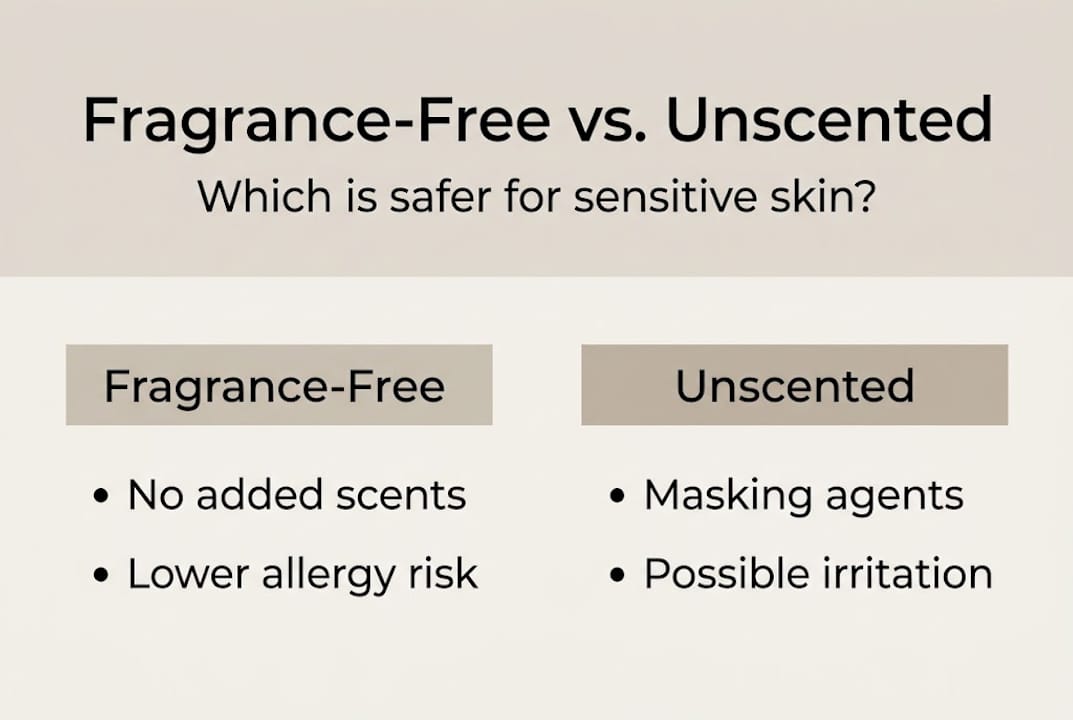
| Label | Contains fragrance? | Masking agents? | Safe for sensitive skin? |
|---|---|---|---|
| Fragrance-free | No | No | Generally yes |
| Unscented | Possibly | Often yes | Not guaranteed |
| Scented | Yes | May also include | Higher risk |
When reading a label, look beyond the word “fragrance” itself. Hidden fragrance sources include:
- Essential oils (lavender, eucalyptus, citrus)
- Botanical extracts with inherent scent compounds
- Linalool, limonene, geraniol, citronellol listed as individual ingredients
- “Parfum” which is the European term for fragrance blend
The safest approach is to use the fragrance-free skincare guide framework: if a product claims to be fragrance-free but lists essential oils or “parfum” in the ingredients, it is not truly fragrance-free by clinical standards.
Regulatory definitions vary by country, which adds another layer of confusion. In the U.S., the FDA does not require brands to disclose individual fragrance ingredients, making label reading a skill worth developing rather than assuming the front-of-pack claim tells the whole story.
Natural vs. synthetic fragrance: Allergy risks and hidden triggers
If you have ever reached for a product labeled “made with natural ingredients” thinking it was the safer choice, you are not alone. The assumption that natural equals gentle is deeply embedded in skincare marketing. The biology does not support it.
Natural fragrances can be equally allergenic as synthetic counterparts. Essential oils like citrus, peppermint, lavender, and tea tree are among the most common triggers for contact allergies in skincare users.
Here is why: Fragrances act as haptens, small molecules that bind to skin proteins and trigger a Type IV hypersensitivity response. This is a delayed immune reaction, not an immediate one. Oxidized terpenes, like linalool hydroperoxides found in lavender oil, are particularly problematic because they become more allergenic as the product ages.
| Fragrance type | Common examples | Reaction rate notes |
|---|---|---|
| Natural | Lavender, citrus, peppermint, geraniol | High sensitization potential |
| Synthetic | Musk compounds, aldehydes | Variable, some highly regulated |
| Oxidized naturals | Aged lavender, linalool hydroperoxides | Increased allergenicity over time |
Pro Tip: Check the expiration date on products containing essential oils. As these oils oxidize over time, their allergenic potential actually increases. An older bottle of “natural” serum may be more reactive than a fresh one.
Understanding natural skincare ingredient risks is essential before assuming botanical formulas are automatically safer. The benefits of natural skincare are real, but they come with nuance. Natural origin does not equal hypoallergenic.
For sensitive skin, the most protective choice is to avoid both natural and synthetic fragrance additions entirely, regardless of how they are sourced or marketed.
Our perspective: The unsung impact of going truly fragrance-free
At Skin Styles, we think the conversation around fragrance-free skincare has been too narrow for too long. It gets framed as a restriction, something you do only if you have a diagnosed allergy or a flaring skin condition. We see it differently.
Choosing fragrance-free is an act of informed self-care. It is about knowing what you are putting on your skin and choosing simplicity and transparency over sensory marketing. For many people, making the switch leads to calmer skin, fewer unexplained reactions, and a routine that actually feels stable.
That said, we believe in balance. Fragrance is safe for many at low concentrations under current regulations, and for people without sensitivities, a beloved scented product is not inherently harmful. The point is not to create fear. It is to push for transparency and informed choice as the standard, not the exception.
If you want to reduce reactivity in your routine, skincare tips for fewer reactions are a great starting point. The goal is a routine you can trust, every single day.
Explore effective fragrance-free options at Skin Styles
Now that you understand what fragrance-free really means and why it matters, the next step is finding products that match your skin’s needs.

At Skin Styles, we make it easy to shop with confidence. Browse our selection of fragrance-free creams and gels formulated for sensitive and reactive skin types. If you prefer trusted brands with clean formulations, the Cosrx fragrance-free lineup is a popular choice among sensitive skin users. We also carry a range of fragrance-free anti-wrinkle products for those who want effective aging support without the irritation risk. Every product page includes full ingredient transparency so you can make the choice that is right for your skin.
Frequently asked questions
What is the difference between fragrance-free and unscented products?
Fragrance-free contains no added scents, while unscented products may include chemical masking agents designed to neutralize odor, which are still technically fragrances and can still cause reactions.
Is fragrance-free skincare necessary for everyone?
Fragrance-free is strongly recommended for sensitive, allergic, or condition-prone skin, but fragrance is safe for many without sensitivities at the low concentrations used in regulated products.
Are natural fragrances safer than synthetic in skincare?
No. Natural fragrances like essential oils can be just as likely to trigger allergic reactions as synthetic fragrances, and some become more allergenic as they oxidize over time.
What skin issues are linked to fragrance in products?
Fragrances are linked to respiratory issues, migraines, and cognitive problems in sensitive individuals, in addition to contact dermatitis and eczema flare-ups on the skin.