

TL;DR:
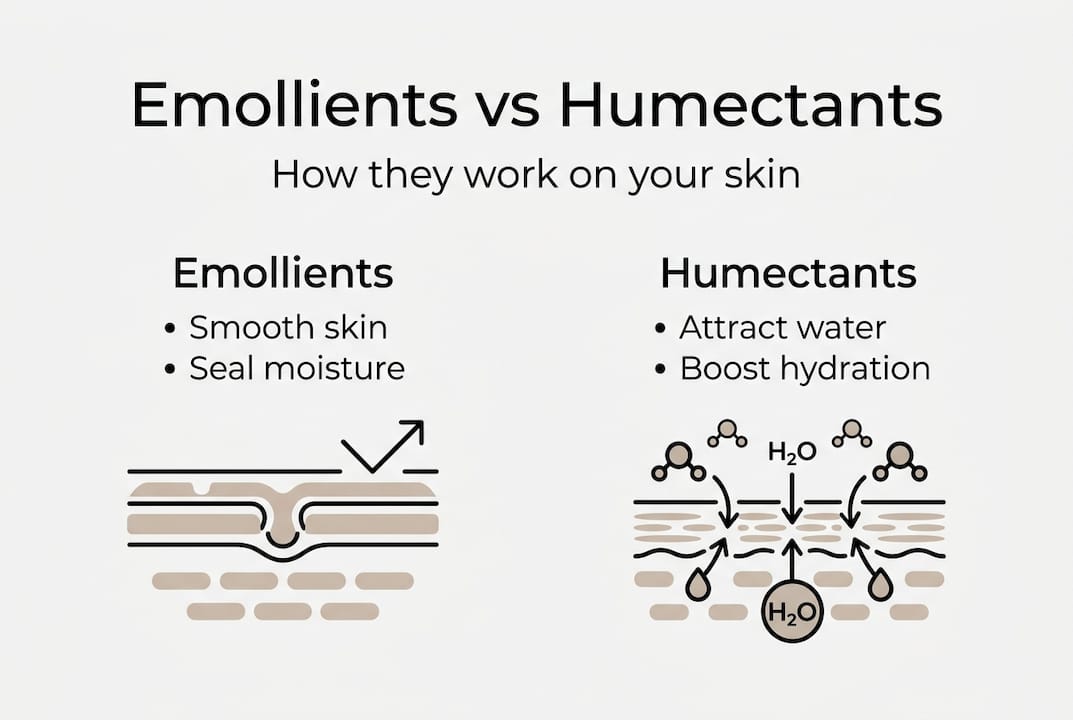
- Emollients smooth skin by filling gaps, while humectants attract water to hydrate.
- Combining both ingredients in skincare routines provides optimal, long-lasting hydration.
- Climate and skin condition determine whether to prioritize emollients, humectants, or both.
Most people assume that slapping on any moisturizer will solve dry or dull skin. The reality is more nuanced, and getting it wrong can actually make your skin worse. Emollients and humectants are two distinct categories of hydrating ingredients, and they work in completely different ways. One draws water into your skin while the other smooths and seals it. Knowing which to reach for, and when, can transform your routine from a guessing game into a strategy that genuinely works. This article breaks down exactly how each type functions, what the research says, and how to build a routine that uses both to your advantage.
Table of Contents
- What are emollients and humectants?
- How do emollients and humectants work differently?
- When should you choose emollients, humectants, or both?
- What research says: Benefits and risks
- Why you shouldn’t pick just one: Our expert view
- Ready to level up your routine?
- Frequently asked questions
Key Takeaways
| Point | Details |
|---|---|
| Different roles | Emollients smooth and seal the skin, while humectants attract water for hydration. |
| Climate matters | Your environment influences whether emollients, humectants, or both are best for your skin. |
| Best results combine both | Most effective routines layer humectants for hydration and emollients for sealing moisture. |
| Read the ingredients | Know what’s in your moisturizer to tailor it to your skin’s unique needs. |
What are emollients and humectants?
Think of your skin’s surface like a brick wall. The “bricks” are your skin cells, and the “mortar” between them is made up of lipids and proteins that keep moisture locked in. When that mortar breaks down, skin feels rough, flaky, and tight. This is where emollients and humectants step in, each playing a different role in restoring that wall.
Emollients are ingredients that fill in the gaps between skin cells, smoothing the surface and making skin feel soft and supple. They don’t add water to your skin. Instead, they restore the lipid matrix that holds everything together. Common emollients include plant oils, shea butter, squalane, ceramides, and petrolatum. They work by forming a thin, flexible film over the skin that reduces water loss and improves texture.
Humectants work differently. They are water-attracting molecules that pull moisture from the environment and from deeper skin layers up to the surface. You can read more about the role of humectants and why they’re central to any hydration strategy. The most well-known humectants include:
- Glycerin: holds 10x its weight in water
- Hyaluronic acid: can hold up to 1000x its weight in water
- Urea: draws water and gently exfoliates at higher concentrations
- Propylene glycol: lightweight and fast-absorbing
- Aloe vera: a natural humectant with soothing properties
The sheer water-holding capacity of hyaluronic acid is what makes it such a star ingredient. A single molecule can bind an extraordinary volume of water relative to its size, which explains why even a small amount in a serum can leave skin feeling plumped and bouncy.
Understanding the emollient benefits is just as important. Emollients are especially valuable for people with compromised skin barriers, as they physically restore the protective layer that keeps irritants out and moisture in. Together, these two ingredient types form the foundation of effective moisturization, but they are not interchangeable.
How do emollients and humectants work differently?
With the definitions in place, the next step is understanding how these ingredients actually behave on your skin, because the difference in their mechanisms has real consequences for how and when you use them.
Emollients integrate into the spaces between skin cells, filling in micro-cracks and creating a smooth, even surface. This is why products rich in emollients feel luxurious and leave skin looking visibly healthier almost immediately. They also reduce transepidermal water loss (TEWL), which is the rate at which water evaporates from your skin into the air. Lower TEWL means your skin stays hydrated longer.
Humectants, on the other hand, are hygroscopic. They actively attract and bind water molecules. When you apply a humectant-rich serum, it draws moisture up from the deeper layers of your skin and, in humid conditions, from the air around you. The key phrase there is “in humid conditions.” We’ll come back to why that matters.
Here’s a quick comparison of how each type performs:
| Feature | Emollients | Humectants |
|---|---|---|
| Primary action | Fill gaps, smooth texture | Attract and bind water |
| Skin feel | Rich, silky, nourishing | Light, plumping, dewy |
| Works best in | Any climate | Humid environments |
| Ideal for | Dry, rough, or barrier-damaged skin | Dehydrated or dull skin |
| Typical ingredients | Shea butter, squalane, ceramides | Glycerin, hyaluronic acid, aloe |
Research supports the idea that timing and formulation matter. One clinical trial found that a Dove moisturizer with humectant-rich properties maintained baseline moisture levels most effectively at 15 minutes post-application, suggesting humectants deliver fast initial hydration.
“Emollients show superior hydration retention in some studies, while humectant-rich formulas may peak quickly but require pairing with barrier-supporting ingredients to sustain results.”
This tells us that neither type is universally superior. Humectants win on speed; emollients win on longevity. The smartest approach combines both. Explore hydration ingredients that blend these two mechanisms for sustained results.
Pro Tip: Apply your humectant serum to slightly damp skin right after cleansing, then follow immediately with an emollient moisturizer. This traps the water the humectant just attracted before it can evaporate. Timing here is everything. Check out these moisturizer selection tips for more guidance on building a layered routine.
When should you choose emollients, humectants, or both?
Here’s where things get practical. The right choice depends on three factors: your skin type, your environment, and your current skin concern. Getting this wrong is one of the most common mistakes in skincare routines.
Climate plays a bigger role than most people realize. Humectants need ambient moisture to do their job properly. In a humid environment, they pull water from the air into your skin. But in a dry environment, humectants in low humidity below 40 to 70% relative humidity can actually pull water from deeper skin layers up to the surface, where it then evaporates. This increases TEWL and can leave your skin more dehydrated than before.
Here’s a simple decision framework:
- In high humidity: Humectants shine. Use a lightweight hyaluronic acid serum and follow with a light emollient to lock in the moisture they’ve attracted.
- In winter or dry climates: Lean heavily on emollients. Use a richer cream with ceramides or shea butter, and if you use a humectant, always seal it with an emollient on top.
- For oily or acne-prone skin: Opt for lightweight liquid emollients like squalane or jojoba oil, and use glycerin as your humectant. Avoid heavy occlusive emollients that can clog pores.
- For eczema or compromised barriers: Prioritize emollients. They physically repair the barrier. Add humectants only when sealed properly.
- For aging or dull skin: Combine both. Humectants plump fine lines; emollients restore the smooth, healthy glow that comes from a strong barrier.
| Skin type or condition | Best primary choice | Pairing recommendation |
|---|---|---|
| Dry, flaky skin | Emollient | Add a humectant underneath |
| Dehydrated, dull skin | Humectant | Seal with an emollient |
| Oily or acne-prone | Lightweight emollient | Use glycerin-based humectant |
| Sensitive or eczema-prone | Emollient | Pair carefully with humectant |
| Normal to combination | Both | Layer based on season |
Pro Tip: In winter, add a facial oil (an emollient) over your usual moisturizer as the final step. It acts as a physical barrier against cold, dry air. This one small change can prevent the tight, uncomfortable feeling many people get in colder months. Learn more about moisturizer types and how to match them to your season.
What research says: Benefits and risks
The science on both ingredient types is solid, and it’s worth knowing what studies actually show rather than relying on marketing claims.
Emollients have a strong evidence base, particularly for barrier repair and inflammatory skin conditions. A large clinical study found that daily emollient use in infants reduced atopic dermatitis incidence by 16% (RR 0.84) at 24 months. That’s a meaningful reduction in a condition that affects millions of children worldwide.
“Daily emollient therapy starting in early infancy significantly reduces the risk of developing atopic dermatitis, with a relative risk of 0.84 at 24 months.”
For adults, emollients are proven to reduce scaling, itching, and skin tightness in conditions ranging from mild dryness to chronic eczema. They also support the emollients for sensitive skin use case, making them a go-to for anyone dealing with reactive or easily irritated skin.
Humectants also deliver proven benefits, particularly for immediate hydration and skin plumping. However, the risks of misuse are real:
Benefits of humectants:
- Fast, visible plumping effect
- Improves skin texture and radiance quickly
- Works well in layered routines
- Lightweight, suitable for most skin types
Risks of humectants (when used incorrectly):
- Can increase TEWL in dry climates if not sealed
- May cause irritation at high concentrations (especially urea above 10%)
- Overuse without emollient pairing can lead to cyclical dehydration
Benefits of emollients:
- Long-lasting barrier repair
- Reduces TEWL significantly
- Proven efficacy for eczema and sensitive skin
- Suitable for all ages, including infants
Risks of emollients (when used incorrectly):
- Heavy formulas can clog pores in oily skin
- Some plant oils can trigger reactions in sensitive individuals
- Overuse of occlusives can interfere with skin’s natural breathability
The research-backed rule is simple: use humectants to attract moisture and emollients to retain it. Neither works at its best without the other.
Why you shouldn’t pick just one: Our expert view
The skincare industry loves a hero ingredient. One week it’s hyaluronic acid, the next it’s ceramides. But the real lesson from both research and real-world experience is that most effective formulations combine both, because humectants draw water while emollients seal and smooth. Single-type products are simply less optimal.
We’ve seen this pattern repeatedly: someone switches to a pure hyaluronic acid serum and their skin feels amazing for two weeks, then suddenly feels drier than before. Or someone uses a thick emollient cream and their skin looks smooth but feels oddly flat and tight. Both experiences are the result of using one tool when the job needs two.
The best routines are adaptive. They shift with the seasons, respond to your skin’s current condition, and layer products intelligently. Explore explained moisturizer types to understand how to build that kind of flexibility into your daily routine. Read ingredient lists. If a moisturizer only lists humectants and no emollients, it’s incomplete for most skin types. The most effective products, and the most effective routines, use both in the right order.
Ready to level up your routine?
Now that you understand how emollients and humectants work, you can shop with real intention instead of just grabbing whatever looks promising on the shelf.

At Skin-Styles.com, we carry a curated range of facial creams and gels that blend both emollient and humectant ingredients for balanced, effective hydration. If you’re looking for science-backed formulas, our Cosrx skincare collection includes bestselling products built around proven hydrating actives. For those focused on long-term skin health and aging concerns, our anti-wrinkle products feature barrier-supporting emollients paired with plumping humectants. Browse by skin concern, ingredient, or brand to find exactly what your routine needs next.
Frequently asked questions
Can I use both emollients and humectants at the same time?
Yes, layering both is often the most effective approach. Combining them means humectants attract water while emollients seal it in, giving you hydration that both works fast and lasts longer.
Which is better for dry environments: emollients or humectants?
Emollients are the safer choice in dry climates. Humectants in low humidity can pull water from deeper skin layers and increase moisture loss if not sealed with an emollient or occlusive on top.
Are emollients safe for sensitive skin?
Yes, emollients are widely recommended for sensitive and eczema-prone skin. Research shows that daily emollient use reduced atopic dermatitis incidence by 16% in infants, making them one of the most trusted options for reactive skin.
How can I tell if my moisturizer has emollients or humectants?
Check the ingredients list. Humectants like glycerin or hyaluronic acid appear near the top if they’re a key ingredient, while emollients like shea butter, squalane, or plant oils typically appear in the middle to lower portion of the list.