

TL;DR:
- Choosing the right feeding spoon supports early self-feeding, motor development, and confidence.
- Messy attempts are a natural part of learning, so patience and routine are key.
- A hybrid approach combining spoon-feeding and baby-led weaning offers balanced nutrition and skill-building.
Most parents assume any spoon will do when starting solids. It fits in the hand, it holds food, and the baby will figure it out eventually, right? Not quite. The spoon you choose and how you use it can meaningfully shape whether your child builds self-feeding confidence early or struggles with mealtime frustration for months. Feeding utensils are more than tools for getting food from bowl to mouth. They are developmental instruments that support fine motor growth, mealtime independence, and even your child’s relationship with food. This guide walks you through the science, the design details, the strategies, and the honest trade-offs so you can make choices that actually work.
Table of Contents
- Why feeding spoons matter in early development
- Choosing the right spoon: Design, material, and safety
- Mealtime strategies: Teaching self-feeding with spoons
- Spoon-feeding vs. baby-led weaning: What’s best for your child?
- What most parents overlook about feeding spoons
- Support mealtime success with quality choices
- Frequently asked questions
Key Takeaways
| Point | Details |
|---|---|
| Guides developmental milestones | Feeding spoons help infants transition to solids and reach key self-feeding milestones. |
| Design impacts safety | Proper material and shape choices in spoons make mealtime safer and easier for young children. |
| Practice builds skills | Repeated, responsive mealtime strategies help toddlers master spoon use and foster independence. |
| No one-size-fits-all | A blend of spoon-feeding and baby-led weaning, adapted to your child, often gives the best results. |
Why feeding spoons matter in early development
The shift from milk to solid foods is one of the biggest transitions in your baby’s first year. Starting solid foods typically begins around 4 to 6 months, when babies show signs of readiness like sitting with support and showing interest in what you are eating. A feeding spoon is the first utensil that bridges that gap, introducing purees in a form babies can safely explore.
But the spoon’s role goes well beyond delivery. It becomes one of your child’s earliest tools for learning cause and effect, practicing grip, and building the muscle memory that leads to independent eating. These are not small wins. They are foundational steps.
Here is how self-feeding typically unfolds:
- 4 to 6 months: Baby accepts spoon-fed purees and begins mouthing the spoon
- 6 to 9 months: Shows interest in holding the spoon independently
- 9 to 12 months: Attempts scooping, even if messy and inconsistent
- 15 to 18 months: Begins using a spoon with some success
- 24 to 30 months: Spoon mastery is largely achieved, with scooping and bringing food to mouth reliably
These milestones are not just about nutrition. They reflect growing fine motor skills that will later support writing, drawing, and other precise hand movements. When you pair spoon practice with finger foods, you give your child two complementary paths to developing hand-eye coordination and grip strength.
“Mealtime is not just about eating. It is one of the richest environments for early learning, sensory exploration, and building confidence in your child’s own abilities.”
Messes are not a sign things are going wrong. They are evidence that your child is actively experimenting. Spilled food, awkward grips, and food on the forehead are all part of the process. Supporting feeding routines for infants that are consistent and low-pressure makes it easier for babies to practice without anxiety.
Pro Tip: Keep a dedicated “practice spoon” at each meal, separate from the one you use to feed your baby. Letting your child hold and mouth their own spoon while you feed them with another builds familiarity and speeds up independent use.
Good feeding set hygiene also matters here. Spoons that are easy to clean and free from cracks or residue keep your baby safe as they mouth and explore their utensils throughout the day.
Choosing the right spoon: Design, material, and safety
Not all spoons are created equal, and the differences matter more than most parents expect. A spoon that is too deep, too long, or too hard can make self-feeding harder and even uncomfortable for a small mouth.
When choosing baby utensils, focus on these key design features:
- Handle length: Shorter handles give toddlers more control. Long handles shift the balance point away from the hand, making accurate scooping harder.
- Grip width: A wider, chunkier grip is easier for small hands that cannot yet pinch precisely.
- Bowl depth: Shallow bowls are better for early self-feeders. Deep bowls require more wrist rotation to empty cleanly.
- Material: Soft silicone is the top recommendation for babies. It is gentle on emerging teeth and gums, flexible enough to prevent injury, and easy to sanitize.
Here is a quick comparison of spoon types by stage:
| Stage | Best spoon type | Key features |
|---|---|---|
| 4 to 6 months | Parent-led silicone spoon | Soft tip, shallow bowl, long handle for caregiver |
| 6 to 12 months | Dual-purpose starter spoon | Short handle, wide grip, soft silicone bowl |
| 12 to 24 months | Self-feeding training spoon | Chunky grip, angled bowl, non-slip handle |
| 24 months and up | Toddler utensil set | Lightweight, slightly deeper bowl, fork included |
Safe baby utensil examples often share these traits: smooth edges with no sharp seams, BPA-free materials, and one-piece construction that avoids pieces that could detach.
According to feeding specialists, ideal spoon mechanics include short handles, wide grips, and bowl depth matched to the child’s current skill level, with silicone as the preferred material for safety and comfort.
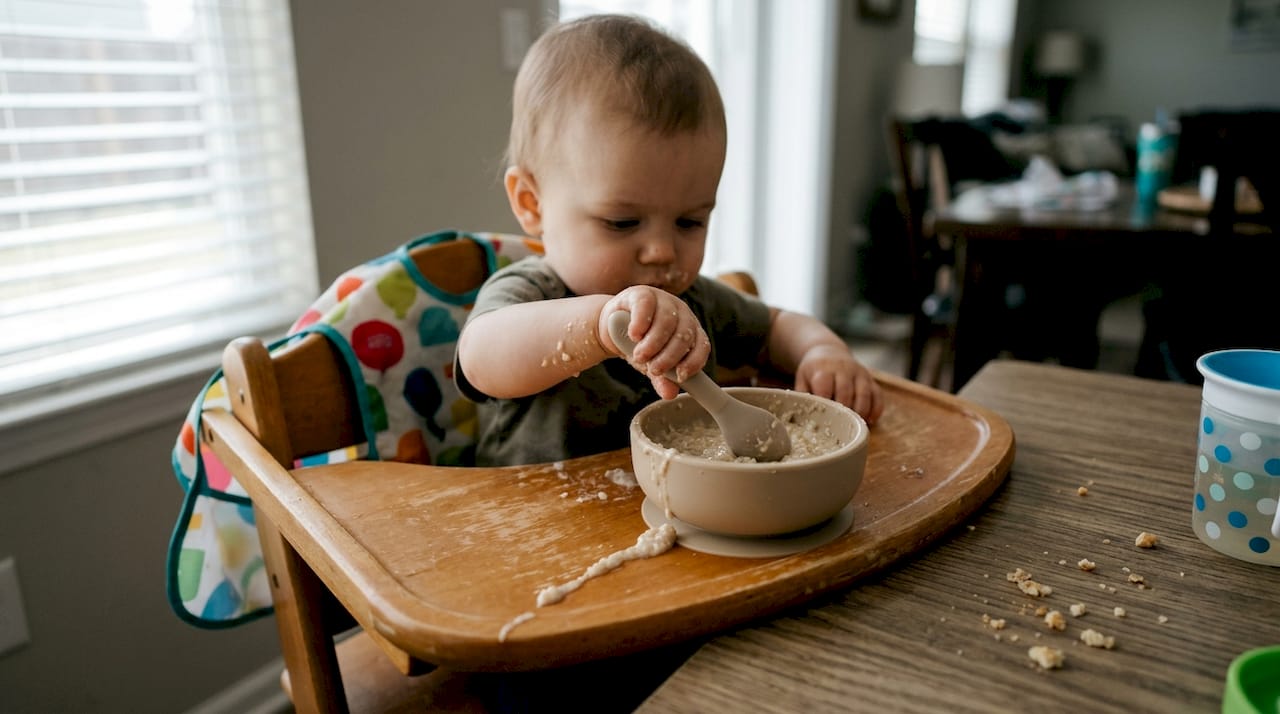
Avoid metal spoons for young babies. They are hard, cold, and unforgiving on sensitive gums. Plastic can work but tends to crack over time, creating hidden crevices where bacteria grow.
Pro Tip: Pair your baby’s spoon with a suction bowl or plate. When the bowl stays put, your child can focus energy on scooping rather than chasing the dish around the tray. This one change can dramatically reduce frustration during early self-feeding attempts.
Mealtime strategies: Teaching self-feeding with spoons
Having the right spoon is step one. Using it well is step two. The way you structure mealtimes has a direct impact on how quickly your child builds confidence and skill.
Here is a practical progression to follow:
- Preload the spoon: Scoop food onto the spoon and hand it to your child. This removes the hardest part of self-feeding early on and lets them focus on the motion of bringing food to their mouth.
- Model the action: Eat alongside your child at the table. Babies are wired to imitate. Watching you use a spoon repeatedly is one of the most effective teaching tools available.
- Use hand-over-hand guidance: Gently place your hand over your child’s and guide the spoon motion. Fade this support gradually as their control improves.
- Praise the attempt, not just the result: Positive reinforcement for trying, even when food lands on the chair, builds persistence and reduces frustration.
- Keep sessions short: Toddlers lose focus quickly. Two to three practice attempts per meal is enough without overwhelming them.
Developmentally, 12 to 14 months is when most children begin bringing a spoon to their mouth independently. Scooping reliably typically comes around 24 months, and fork use follows around 30 to 36 months. Gagging is normal and expected through about 10 months as babies learn to manage textures.
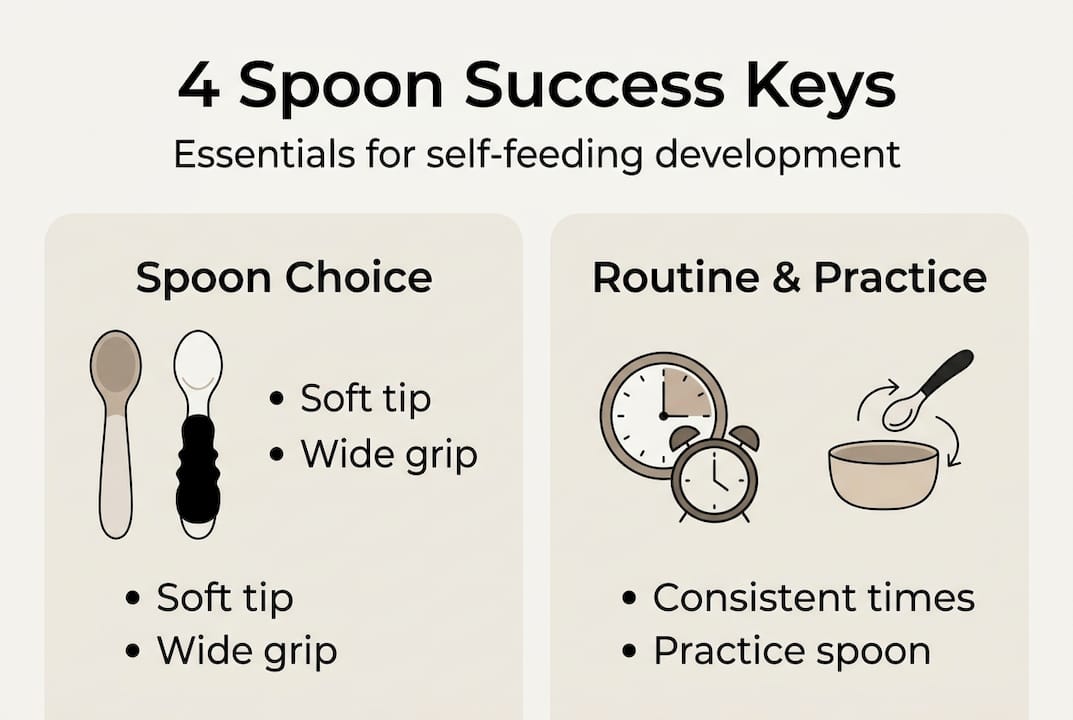
Responsive feeding, which means following your child’s hunger cues and letting them set the pace, is central to this process. Preloading spoons, modeling use, and praising attempts are all part of a responsive approach that respects your child’s developing autonomy.
Pro Tip: Offer two spoons at every meal, one for your child to hold and one preloaded for them to use. This reduces the battle for control and keeps the meal moving.
Consistent feeding routines also reinforce learning. When meals happen at the same time, in the same place, with the same utensils, your child’s brain builds stronger associations with the expected behavior.
Spoon-feeding vs. baby-led weaning: What’s best for your child?
The debate between spoon-feeding and baby-led weaning (BLW) has been loud in parenting circles for years. BLW means offering soft finger foods from the start and letting babies self-feed without purees or spoons. Both approaches have real strengths and real limitations.
Spoon-feeding advantages:
- Greater control over nutrition and calorie intake
- Easier texture progression from thin purees to thicker foods
- Lower risk of choking with appropriate purees
- Useful when iron-rich foods need to be prioritized
BLW advantages:
- Promotes independence and hand-eye coordination earlier
- Exposes babies to a wider variety of textures and flavors
- Encourages self-regulation of hunger and fullness
The trade-offs are real. BLW carries a 12% gagging or choking rate compared to spoon-feeding, and babies may consume fewer calories and less iron in early months. Spoon-feeding offers more nutritional control but may slow the development of independent feeding behaviors if used exclusively.
“The method matters less than the environment. A warm, responsive, distraction-free mealtime supports healthy eating regardless of whether a spoon or a finger food leads the way.”
Interestingly, long-term differences in fussiness between BLW and spoon-fed children are minimal. Family practices like breastfeeding history and household food culture appear to influence eating behavior more than the weaning method itself.
For most families, a hybrid approach works best. Use spoons for purees and iron-rich foods while offering appropriate finger foods alongside. Safety research consistently supports hybrid methods as the most balanced path for nutrition and self-feeding skill development. When in doubt about choosing safe utensils for either approach, prioritize soft materials and age-appropriate sizing.
What most parents overlook about feeding spoons
Here is something worth sitting with: most parents treat the feeding spoon as a convenience item, something to get food in without too much mess. The real opportunity is bigger than that.
Every time your child picks up a spoon and tries, they are not just practicing eating. They are building a belief that they can figure things out on their own. That sense of mastery, earned through repeated attempts and small wins, is one of the earliest forms of self-confidence a child develops. A spoon is a confidence-building tool disguised as kitchenware.
Parents often fixate on the mess and miss the milestone underneath it. The food on the floor is not failure. It is evidence of effort. When you reframe messiness as progress, you show up differently at the table, with more patience and more celebration.
Building healthy feeding routines around consistent spoon practice is one of the highest-return investments you can make in your child’s early development. The window for building these skills with ease is relatively short. Use it well.
Support mealtime success with quality choices
Getting mealtime right takes more than good intentions. It takes the right tools and a commitment to safe, nurturing routines. At Skin Styles, we believe that caring for your child starts with thoughtful choices across every category, from the utensils they use to the products that keep their skin healthy and comfortable.

Whether you are building out your baby’s feeding kit or looking for gentle skincare solutions to pair with your daily care routine, our collections are curated with quality and safety in mind. Explore our facial creams and gels for soft, nourished skin, or browse our facial cleansers collection for gentle daily care. Supporting your child’s wellbeing from mealtime to bathtime is what we are here for.
Frequently asked questions
At what age should I introduce a feeding spoon to my baby?
Most babies are ready to start using a feeding spoon with purees around 4 to 6 months if they can sit with support and show interest in solid foods.
What type of spoon is safest for a baby learning to self-feed?
Spoons with short handles, wide grips, smooth edges, and soft silicone construction are safest. Ideal spoon design matches the bowl depth and grip size to your child’s current developmental stage.
Is messiness normal when babies learn to use spoons?
Absolutely. Messiness is a healthy and expected part of skill development. Messes are expected, and hand-over-hand guidance can help babies build accuracy over time without pressure.
Should I use only spoon-feeding or combine it with baby-led weaning?
A hybrid approach tends to work best for most families. Hybrid methods balance nutritional control with the independence-building benefits of self-feeding, while keeping safety a priority throughout.