

TL;DR:
- Building a skincare routine requires understanding your skin type and needs.
- Core steps include cleansing, moisturizing, and applying sunscreen consistently.
- Simplicity and patience lead to better, lasting skin health than trendy or complex routines.
Building a skincare routine feels straightforward until you’re staring at a shelf of 12 products and zero clarity on what goes first. Most people either skip steps that actually matter or pile on too many products that cancel each other out. This guide cuts through that noise. Using expert-backed insights and real dermatological science, you’ll learn exactly how to identify your skin’s needs, layer products correctly, and personalize your routine for lasting results. Whether you’re starting from scratch or fine-tuning what you already do, the steps ahead will make your regimen work harder for you.
Table of Contents
- Understanding your skin type and its needs
- Building the perfect base: Core steps for every routine
- Personalizing your routine by concern and age
- Avoiding common mistakes and troubleshooting sensitive skin
- Why simplicity and consistency outperform fads
- Your proven path to healthier skin starts here
- Frequently asked questions
Key Takeaways
| Point | Details |
|---|---|
| Know your skin type | Identifying if your skin is oily, dry, sensitive, or combination helps you choose the right products. |
| Start with core steps | Every routine should start with gentle cleansing, moisturizing, and sunscreen daily for best results. |
| Personalize by concern | Customize your routine for anti-aging, acne, or other concerns with the right treatments and timing. |
| Avoid common mistakes | Too many actives or over-exfoliating can damage your skin barrier—simplify if irritation occurs. |
| Consistency is key | Stick to your routine and give it time—real improvements show up over weeks, not days. |
Understanding your skin type and its needs
Before you buy a single new product, you need an honest read on your skin. Most people guess their skin type based on one bad day, a dry winter morning, or an oily afternoon, and then build an entire routine around that guess. That’s a setup for frustration.
The five most common skin types are:
- Oily: Shiny appearance, enlarged pores, prone to breakouts
- Dry: Tight feeling, flaking, dull tone, fine lines more visible
- Combination: Oily in the T-zone (forehead, nose, chin), dry or normal on cheeks
- Sensitive: Reacts easily to products or environment, redness, stinging
- Normal: Balanced, few concerns, minimal oiliness or dryness
A simple way to check: wash your face with a gentle cleanser, pat dry, and wait 30 minutes without applying anything. If your skin looks shiny all over, it’s oily. If it feels tight or looks flaky, it’s dry. A mix of both zones points to combination. Redness or tingling after cleansing often signals sensitivity.
Your skin type isn’t fixed. Hormones, climate, age, stress, and even your diet shift it over time. Someone who was oily at 22 may find their skin runs drier at 38. Checking in with your skin seasonally keeps your routine relevant.
Why does this matter so much? Because the right products for your type make a measurable difference. Tailoring your routine to skin type means oily skin benefits from lightweight gels and oil-control ingredients like niacinamide and salicylic acid, while dry skin needs creamy, hydrating formulas rich in ceramides and hyaluronic acid. Sensitive skin does best with fragrance-free, soothing products, and combination skin needs a balanced approach that doesn’t over-correct either zone.
This matters even more if you’re thinking about anti-aging tips, since the wrong base products can undermine even the most targeted treatments.
Pro Tip: Before adding any new product to your routine, patch test it on the inside of your wrist or behind your ear for 24 to 48 hours. This catches reactions before they spread across your whole face.
Building the perfect base: Core steps for every routine
Now that you know your skin type, it’s time to build a fail-safe foundation. The good news is that an effective routine doesn’t need to be complicated. Three steps are non-negotiable for everyone.
The core steps, in order:
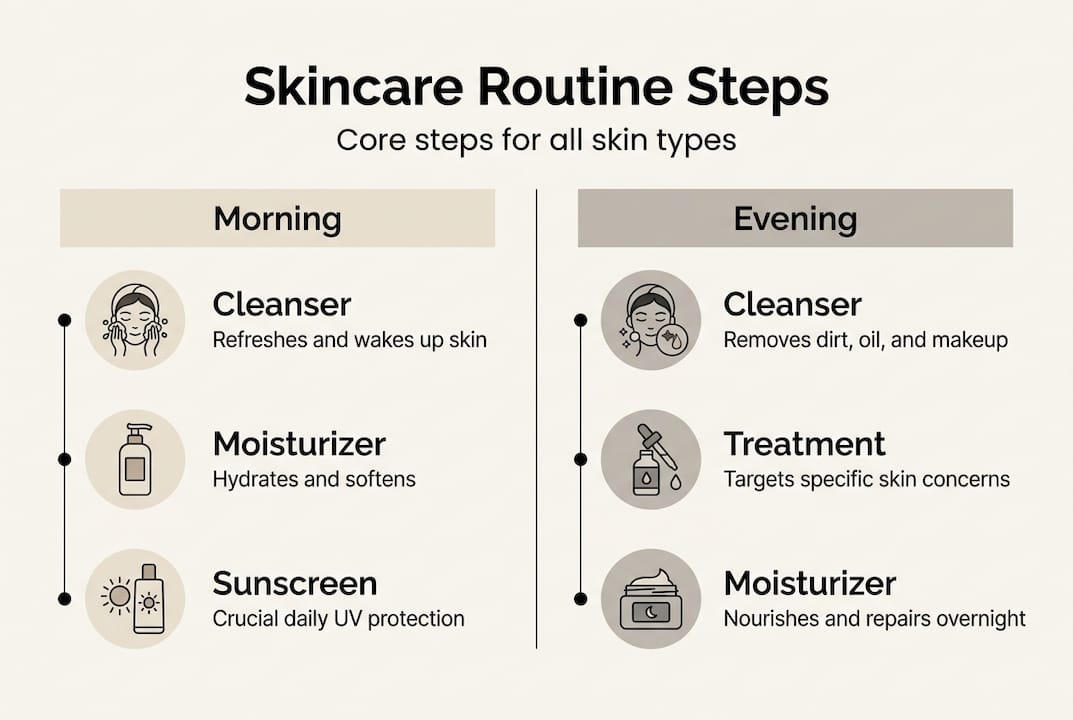
- Cleanse (AM and PM): Removes dirt, oil, and environmental buildup. Use a gentle formula that doesn’t strip your barrier.
- Moisturize (AM and PM): Locks in hydration and supports barrier function. Even oily skin needs this.
- Sunscreen (AM only): Protects against UV damage, the leading cause of premature aging.
These three core steps form the backbone of any routine, regardless of skin type, age, or budget. Everything else, including toners, serums, essences, and eye creams, is optional and added based on your specific concerns.
When you’re ready to add more steps, layering matters more than most people realize. The golden rule is thinnest to thickest. A water-based serum goes on before a thick moisturizer because it can’t penetrate through a heavier layer. The full application order looks like this: cleanser, toner or essence, serum or treatment, eye cream, moisturizer, and SPF in the morning.
Here’s a quick look at how single-step and multi-step routines compare:
| Routine type | Time required | Benefit level | Best for |
|---|---|---|---|
| Single-step (cleanser + SPF) | Under 2 minutes | Baseline protection | Beginners, travel |
| 3-step core | 3 to 5 minutes | Strong foundation | Most skin types |
| Multi-step (5+ steps) | 10 to 15 minutes | Maximum results | Targeted concerns |
Multi-step routines can improve superficial hydration by up to 92% compared to basic routines, which is a significant jump for anyone dealing with dryness or dullness. You can also explore a basic skincare workflow to map out your own schedule.
Pro Tip: Apply sunscreen as the last step in your morning routine and use about a quarter teaspoon for your face alone. Most people apply far too little, which cuts the protection factor dramatically.
Personalizing your routine by concern and age
With the foundation set, specific life stages and skin concerns shape your next steps. A 24-year-old managing acne has very different needs than a 45-year-old focused on firmness, even if both have oily skin.
Here’s a general guide to matching concerns with ingredients:
| Skin concern | Key ingredients | When to start |
|---|---|---|
| Dullness and uneven tone | Vitamin C, niacinamide, AHAs | Any age |
| Acne and breakouts | Salicylic acid, benzoyl peroxide, retinol | Teens and up |
| Fine lines and wrinkles | Retinoids, peptides, hyaluronic acid | Late 20s onward |
| Hyperpigmentation | Kojic acid, azelaic acid, vitamin C | Any age |
| Dryness and sensitivity | Ceramides, squalane, colloidal oatmeal | Any age |
Retinoids are the most evidence-backed ingredient for aging skin. Retinoids reduce wrinkles by 18 to 52% in clinical studies, making them one of the few ingredients with genuinely strong science behind them. Pair that with daily SPF, and you have a solid anti-aging routine that addresses both prevention and repair.
In your 20s, the focus is prevention: antioxidants like vitamin C protect against environmental damage, and SPF is your most important product. In your 30s, add a retinoid and a targeted serum for any emerging concerns. By your 40s and beyond, richer moisturizers, peptides, and consistent exfoliation help maintain texture and firmness. Understanding the key sunscreen benefits at every age makes a real difference in long-term results.
Lifestyle factors amplify everything. Poor sleep raises cortisol, which breaks down collagen. A diet high in sugar accelerates glycation, a process that stiffens skin proteins. These aren’t small details. You can personalize your skincare steps further by factoring in your environment and daily habits.
Pro Tip: When adding an active like retinol or an acid, start with two nights per week and build up slowly. Rushing the introduction is the most common reason people give up on effective ingredients.
Avoiding common mistakes and troubleshooting sensitive skin
Even the best-laid routines hit snags. Here’s how to troubleshoot and stay resilient when your skin pushes back.
The most frequent mistakes people make include:
- Over-exfoliating: Using acids or scrubs more than two to three times per week damages the skin barrier and causes more problems than it solves
- Stacking too many actives: Mixing retinol, AHAs, BHAs, and vitamin C all at once overwhelms skin and triggers irritation
- Skipping sunscreen: No serum or treatment can undo the daily damage from unprotected UV exposure
- Changing products too fast: Switching before giving a product four to six weeks means you never see real results
Over-exfoliation and too many actives are the leading causes of barrier damage, which shows up as redness, flaking, stinging, and sudden breakouts. If your skin is reacting badly, it’s almost always a sign to simplify, not to add more products.
For sensitive or barrier-damaged skin, strip the routine back to the three core steps and nothing else. Use fragrance-free formulas, avoid all actives temporarily, and focus on moisture and protection. Barrier health and sunscreen are what dermatologists prioritize over any serum or treatment, no matter how well-marketed.
“The less-is-more approach works for most people. A consistent, simple routine beats an inconsistent, complex one every time.” — Dermatology guidance, Brown Health
Knowing when to see a dermatologist matters too. Persistent cystic acne, rosacea flares, or skin that doesn’t respond to any routine after eight weeks deserves professional input. These aren’t failures; they’re signals that prescription-strength solutions or a diagnosis is needed. Reviewing your routine layering tips before your appointment can also help you describe what you’ve already tried.
Pro Tip: To repair a damaged barrier fast, use only a gentle cleanser and a ceramide-rich moisturizer for five to seven days. No actives, no exfoliants. Most people see significant improvement within a week.
Why simplicity and consistency outperform fads
Here’s something the skincare industry doesn’t want you to focus on: the most dramatic skin improvements rarely come from a new product. They come from doing the same three to five steps reliably, every single day, for months.
Influencer content thrives on novelty. A new ingredient, a new routine, a new product. But barrier health and consistent SPF outperform almost every trending serum in dermatological practice. The uncomfortable truth is that most people don’t need more products. They need more patience with the ones they already have.
Small, sustainable changes beat radical overhauls. Swapping one product, tracking your skin’s response for four to six weeks, and adjusting from there is how real progress happens. A 10-step routine you abandon after two weeks does nothing. A three-step routine you follow every morning and night changes your skin over time. Track what you use, note how your skin responds, and resist the pull of the next trending ingredient until you’ve given your current routine a genuine chance.
Your proven path to healthier skin starts here
You now have a science-backed method for building and personalizing a routine that actually works. The next step is equipping yourself with the right products to put it into practice.

At Skin-Styles.com, you’ll find curated selections matched to every step of your new routine. Browse facial cleansers suited to your skin type, explore moisturizers and gels that lock in hydration without clogging pores, and check out targeted anti-wrinkle treatments formulated with proven actives. Every product is chosen to make starting or upgrading your routine straightforward, with options across skin types, concerns, and budgets. Your best skin doesn’t require guesswork. It requires the right tools.
Frequently asked questions
What is the best order to apply skincare products?
Apply products from thinnest to thickest: cleanser, toner or essence, serum or treatment, eye cream, moisturizer, and SPF last in the morning. This order ensures each layer absorbs properly without interference.
How often should I change my skincare routine?
Stick with a routine for at least four to eight weeks before evaluating results. Change your routine only when your skin’s needs genuinely shift, such as with seasonal changes or new concerns.
Can I skip moisturizer if I have oily skin?
No. Oily skin still needs hydration. Skipping moisturizer can trigger your skin to produce even more oil. Choose lightweight formulas for oily skin like gel-based or oil-free options.
How do I know if a product is irritating my skin?
Watch for redness, burning, flaking, or sudden breakouts after introducing something new. These are signs of barrier damage from irritation, and you should stop using the product immediately.
Is sunscreen really necessary every day?
Yes, without exception. Daily sunscreen prevents photoaging and shields skin from UV damage regardless of the weather, season, or your skin tone.